Morbid Hunger


Three damage and three life for that much mana is a rate no removal spell would survive on by itself, which is the whole point of the design: the casting cost is a throwaway, and the card's actual worth lives in its second life out of the graveyard. The flashback bill stacks the burn-and-drain across a long game, so a single card eventually delivers six damage and six life in two installments, with the second arriving in a stalled late game after the first already traded for a body. That arithmetic only repays a patient, grinding shell where tempo loss is acceptable in exchange for raw card-output over time. The drain rider does more than removal alone: against an aggressive curve the three life buys a turn, against an attrition mirror it nudges a race in your favor. The structural idea belongs to a graveyard-value era in which a card's value was measured not by its first use but by its total yield before exile. Strip flashback away and this is a hopelessly overpriced burn spell; keep it and you have a slow two-for-one a deck has to be built to wait on. The steep second cost is the leash on that payoff: a player willing to absorb the slowness gets a card that keeps paying, while the nine-mana recast price ensures the engine grinds rather than dominates.
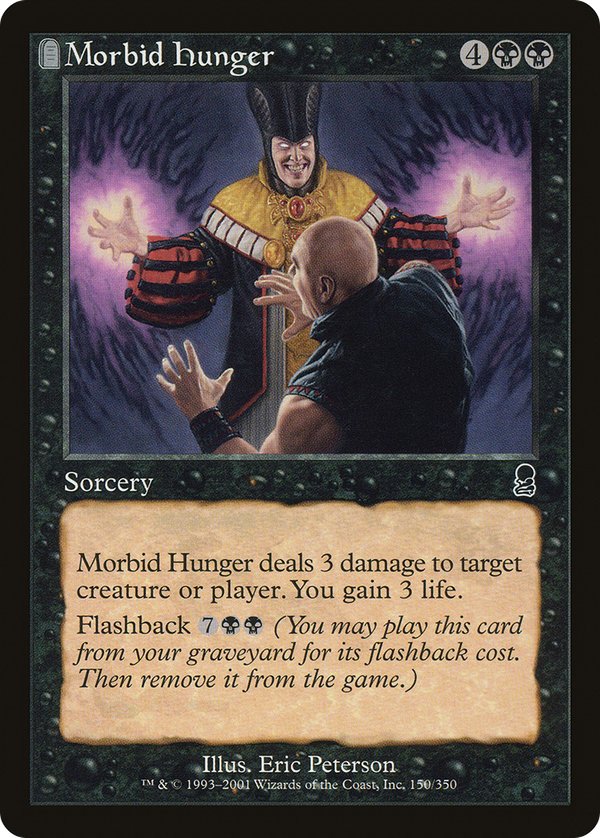
Rules text
 (You may cast this card from your graveyard for its flashback cost. Then exile it.)