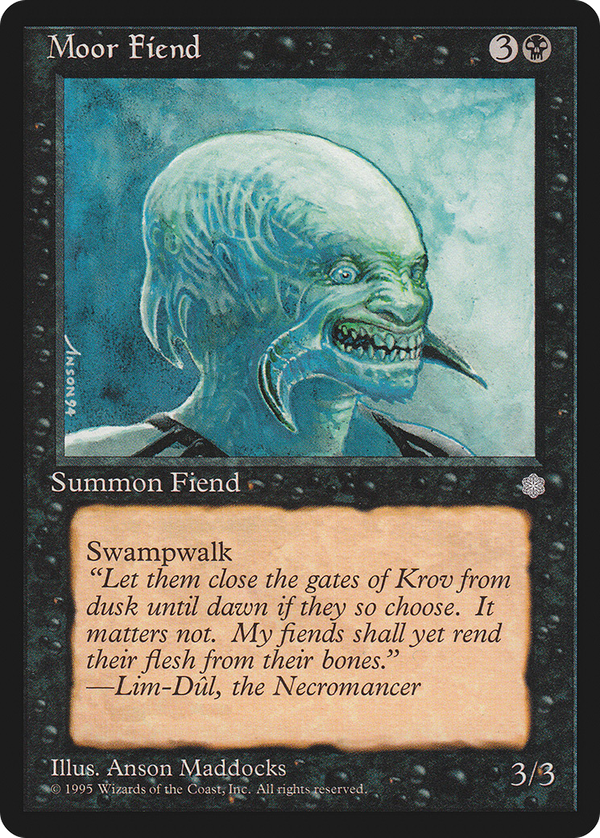
Moor Fiend


Swampwalk is binary by construction: against a player with a Swamp in play this 3/3 simply cannot be blocked, and against everyone else it is a four-mana beater with no compensating bump to its body. There is no middle setting. The keyword belongs to an early notion of evasion, when landwalk was bolted onto creatures at no apparent cost, before designers reckoned with what that ability does to games. When it is live, the opponent has no answer in combat; when it is dead, you have spent four mana on a creature that does nothing the type line does not already promise. The structural tax is the absent stat bonus: the card pays for its ceiling by being merely a 3/3 the rest of the time, and its competitive value is decided not by your sequencing but by whether your opponent's lands cooperate. Swampwalk at least aims at a plane that shows up: black mirrors give it the best odds of mattering. But the core flaw is baked in. An evasion ability that swings between "unblockable" and "vanilla" produces feast-or-famine combat math nobody plans around, because the variable lives entirely on the other side of the table. Moor Fiend is the untuned ancestor of the conditional-evasion creature, the version printed before the cost of that condition was understood and priced.