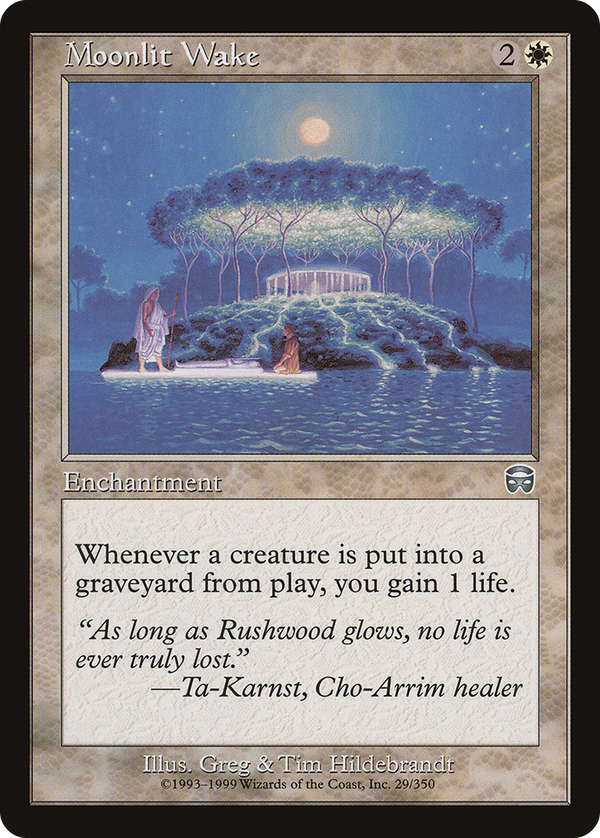
Moonlit Wake


The trigger fires for every creature that dies, regardless of who controlled it, and that universal scope is both the appeal and the ceiling. Each combat exchange, each chump block, each removal spell tacks a point onto your total whether the death helped you or hurt you. As a passive lifegain engine it scales with the board's mortality rather than your own decisions, which makes it real in grindy attrition games where bodies trade constantly and inert when nothing is dying. The indifference is what dates the design. White's later incidental-lifegain enchantments learned to narrow the scope to wring more out of the same slot: gating the trigger behind your own creatures dying, behind specific creature types, or pairing the life with a payoff that turns it into a resource instead of a buffer. Stripped to its plainest form, this just totals up the graveyard and hands you a number, with no downstream engine waiting to spend it. The lineage that follows it is more instructive than the card itself, because it marks the moment before designers worked out that incidental lifegain only earns three mana when something hungry is built to consume the life it produces.