Monk Idealist


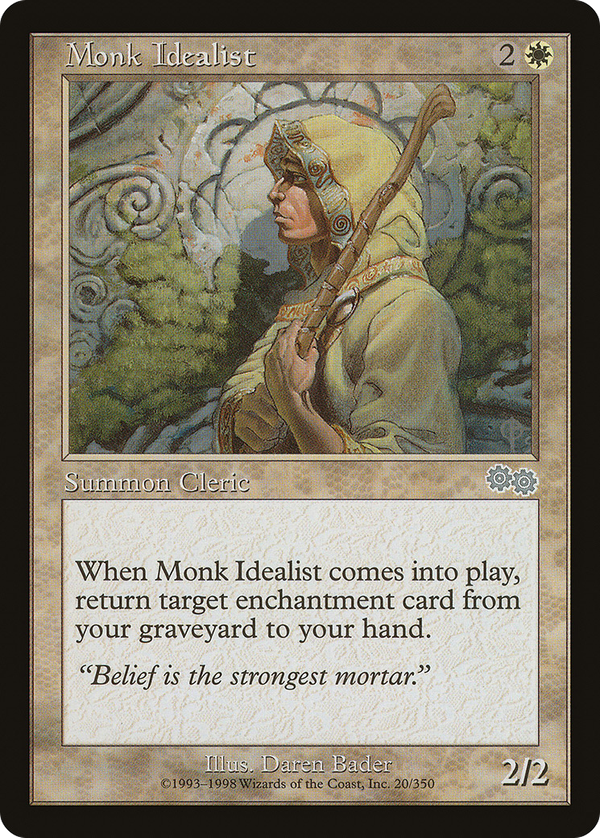
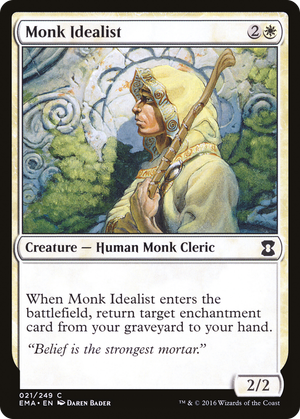
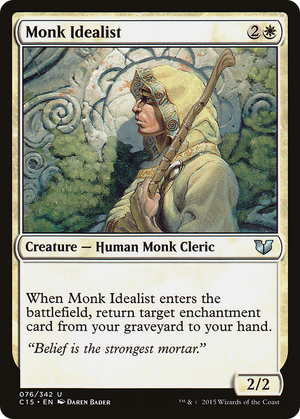
Enchantment recursion in white has a long, quiet history, and this is an early template for it: a body that buys back a piece of your enchantment engine the moment it lands. The design logic is straightforward. White does not draw cards the way blue does, so the color recoups value by reattaching to permanents already paid for, and Monk Idealist staples that recursion to a creature that can also block or trade. You are not just getting the enchantment back; you are getting a 2/2 alongside it, which folds two effects into one slot and rewards decks already leaning on disposable or repeatable enchantments. The balance lever is the target requirement: there must be an enchantment in the graveyard for the trigger to do anything, so the card wants a deck that is already committed before it arrives rather than functioning as a standalone. With nothing in the bin the trigger whiffs and you are left with a 2/2 for three; inside an enchantment shell it becomes a steady stream of replayed Pacifism-style locks, sacrificial auras, or cantrip enchantments coming back for a second loop. The shape it pioneered (creature-as-recursion-engine for a specific card type) recurs throughout white's later toolbox, but the core idea was already legible in this early-era design.