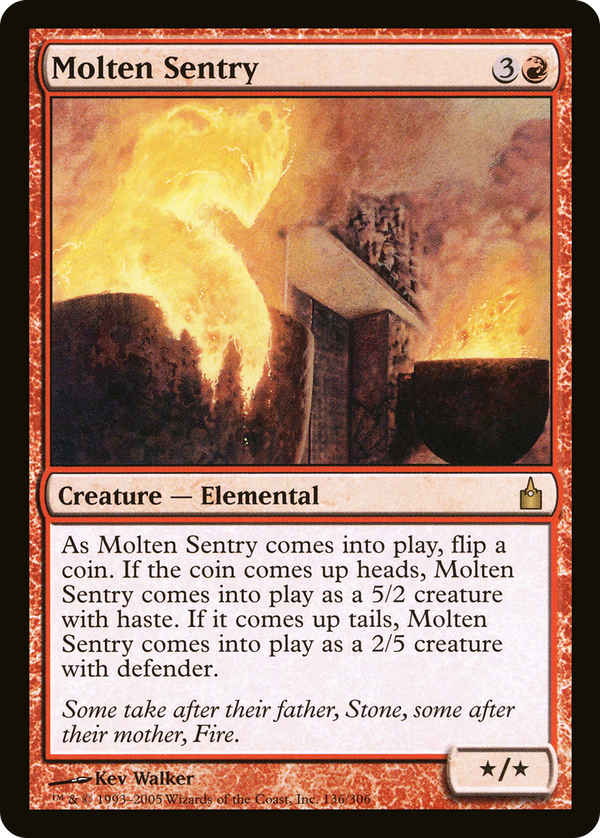
Molten Sentry


The coin decides what you bought, and neither result is the one you hoped for: heads delivers a brittle 5/2 with haste that can crash in immediately but folds to almost any block or burn; tails delivers a 2/5 with defender, a wall that holds a lane and threatens nothing. There is no hedge, no nudge, no middle outcome to settle into. This is variance baked into a permanent rather than a spell, which is the stranger and more uncomfortable place to put it. A coin-flip burn effect resolves and is gone; you suffer the bad flip for an instant. A creature lingers, embodying a choice the game made on your behalf, and the body never even agrees with itself across games: sometimes your aggressive curve-topper, sometimes your defensive anchor, never something you can sequence around in advance. Red has a long tradition of pricing chaos in as a discount, the implicit bargain being that randomness should buy a rate you could not otherwise pay for. The problem is that both faces land right around fair, so the gamble returns nothing: you are flipping to learn whether you got a slightly undersized attacker or a slightly undersized blocker. It is a compact demonstration of why "make it random" and "make it powerful" are different design levers, and why the first one without the second leaves a card with no real reason to exist.