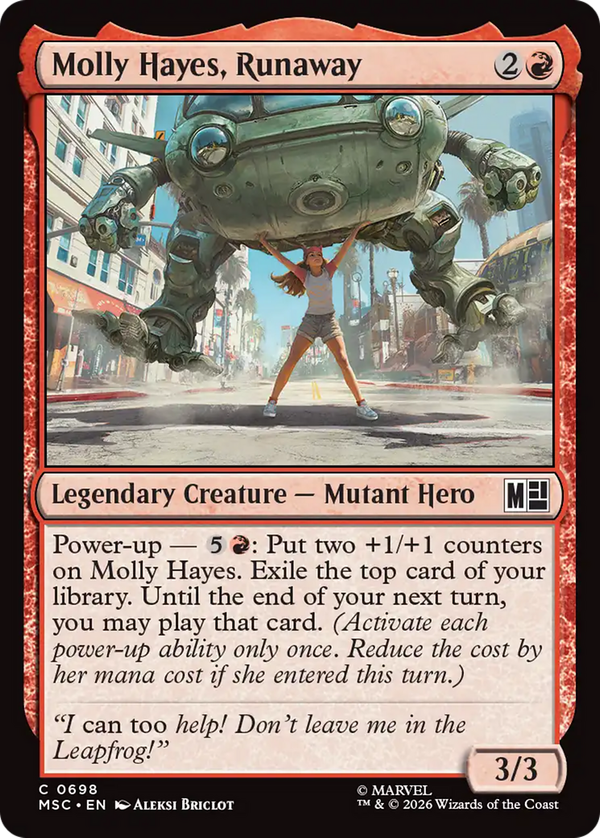
Molly Hayes, Runaway


Power-up loads its whole cost into a single big activation, and the parenthetical rebate is the wrinkle that governs when you can pull the trigger: cast her on turn three for , and if you activate the same turn, the  cost drops by her mana cost to leave a three-mana bill on the table. That does not accelerate the play (the turn-she-lands version still asks for six mana across the spell and the ability), but it does keep the same-turn combo from ballooning to nine, which is the difference between a play you can build toward and one you never make. What the mana buys is not just two counters pushing a 3/3 to 5/5, but the impulse draw riding underneath: exile off the top, hold the option into your next turn. That second clause is where the color-pie tension lives. Red's card advantage has always come with an expiration date, cards it "draws" want to be spent now or lost, and this folds that impulse tax into a body that swells the moment you pay it, so the mana that finds a card also makes the creature harder to block or kill profitably. The once-only cap on the ability is what stops it short of an engine; it is a deliberate one-shot burst, suited to an aggressor converting tempo into pressure before the window shuts rather than grinding out a repeatable loop.
Rules text
: Put two +1/+1 counters on Molly Hayes. Exile the top card of your library. Until the end of your next turn, you may play that card. (Activate each power-up ability only once. Reduce the cost by her mana cost if she entered this turn.)