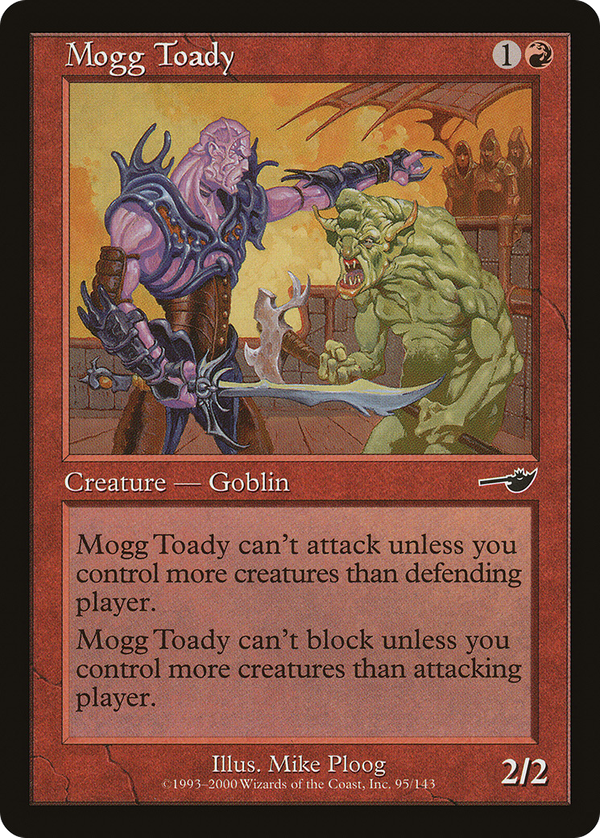
Mogg Toady


The body wants to attack and the rules won't let it: a 2/2 that only swings when you already outnumber the defender, and only blocks when you outnumber the attacker. Those clauses read like a downside bolted onto a vanilla goblin, but the design intent is clearer than the rate suggests. This is a card built to reward a board that is already wide, the kind of go-wide goblin shell that wins by saturating the battlefield before combat math even matters. In that context the restriction is nearly free: if you control more creatures than your opponent, the Toady attacks like any other two-power body, and the static condition gating it is simply met. The trouble is that those restrictions cut hardest in exactly the situations where you want a creature most. Fall behind on board and it cannot block; the one job a 2/2 is supposed to do in a losing race, it refuses. That asymmetry is the whole personality of the card: it is excellent insurance for a deck that is winning and dead weight for a deck that is not. It is a creature with no independent agency, a unit that contributes only as part of a swarm and contributes nothing as the last one standing. The design lineage here is an early experiment in tying a creature's combat permissions to the state of the board, a knob Wizards would tune more gracefully in later goblin cards.