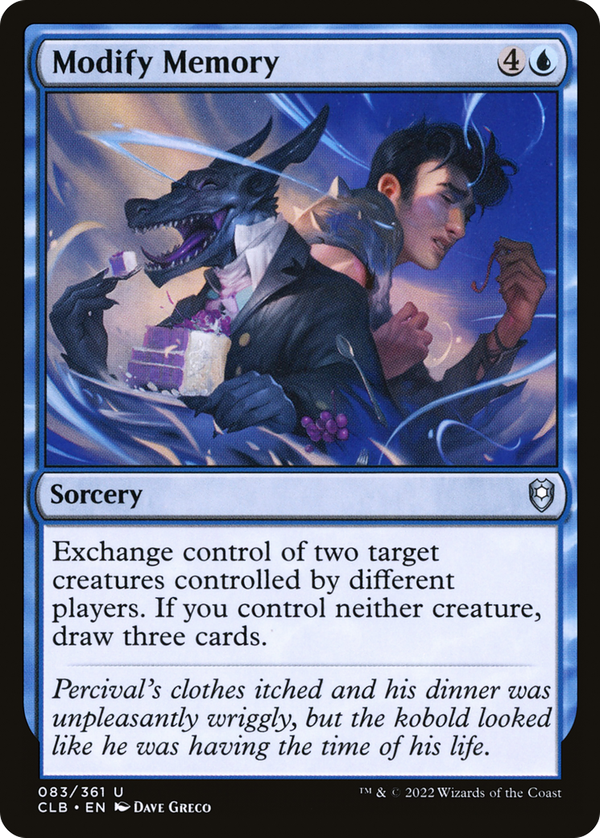
Modify Memory


Most control-swap effects hit the same wall at a multiplayer table: the moment you hand an opponent a creature to take theirs, you have brokered a two-player trade that everyone else watches for free. This one answers with a conditional payoff. The swap forces two creatures across a boundary you do not have to sit on, and if you keep neither, you draw three cards for arranging the exchange. That clause turns the effect from a self-serving grab into a deal-broker's instrument: you can dump a liability on one player, saddle another with something they cannot answer, and get paid in cards for orchestrating a fight your own board sits out of entirely. What matters about moving a creature has as much to do with who ends up holding it as with what it does, and that politics is the whole point. As a sorcery it commits at your own turn's pace, so the swap is a planned intervention rather than a combat trick, which suits the negotiation it invites: you announce the deal, the table reacts, and you profit from the fallout. Strip away the third player and it degrades to a plain trade of your creature for an opponent's, with the draw clause dead on arrival; the engine only fires when there is someone else to route the exchange around.