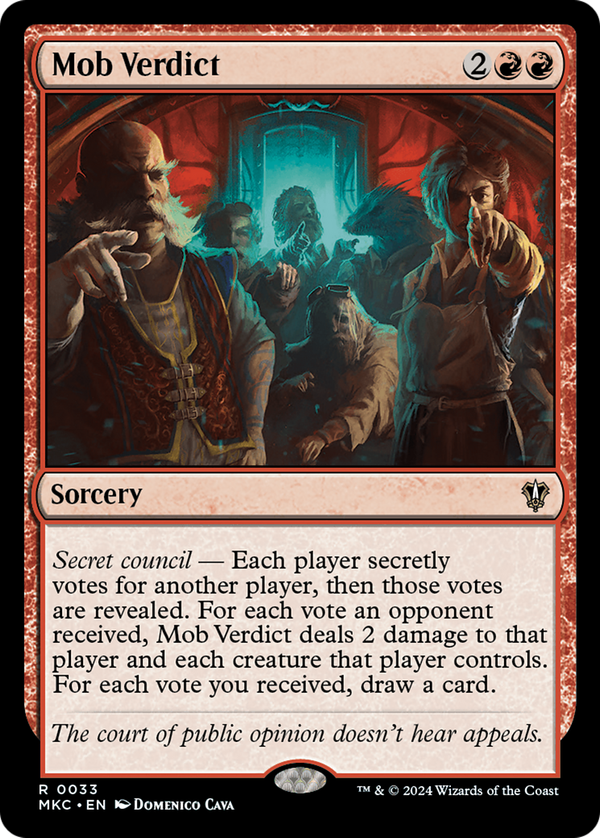
Mob Verdict


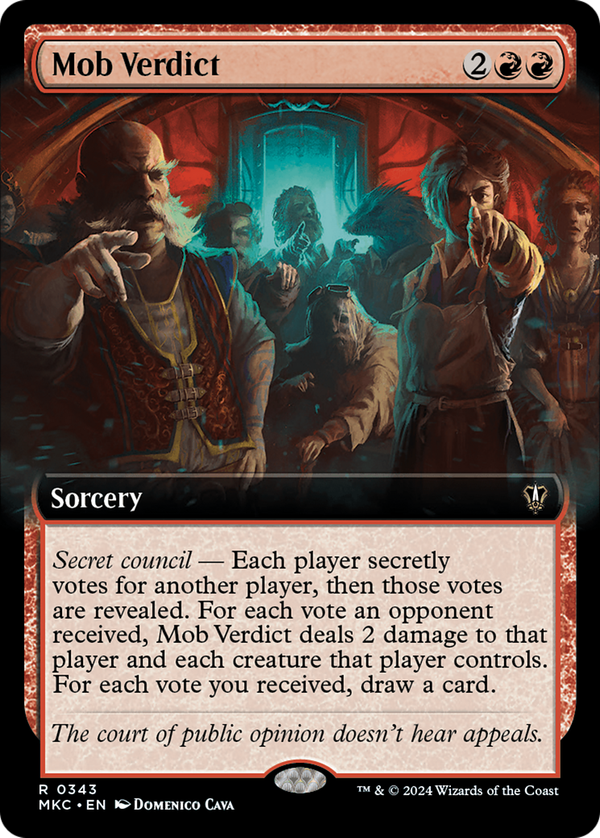
Voting cards live or die by how they turn a shared political decision into a personal one, and this one splits the outcome cleanly down the table. Everyone points a finger at someone else, and each accusation resolves twice over: a vote against an opponent lands as two damage to them and their whole board, so the more thoroughly the table wanted a player gone, the harder the sweep hits them. The caster never takes any of it. That is the first thing to understand: the damage is strictly one-directional, a Pyroclasm aimed only outward, its reach scaled by consensus rather than by mana spent. The self-directed clause is where the design gets clever. Votes that come back to the caster are not a threat but a payout, converting each accusation into a card, with no downside attached. So the incentive is unambiguous: the caster wants to be feared, because fear becomes cards, and the table's paranoia funds the refill. Red's usual price for card advantage is impulsive, either exile-and-play-this-turn draw or rummaging that demands a discard first. Here the draw arrives clean, paid for entirely by the social layer rather than by tempo or life. That is the quiet ambition of the build: it lets red buy cards with politics instead of resources, rewarding whoever reads the room well enough to be both the sweep's author and its beneficiary. Red doing what red rarely gets to do, turning suspicion into cards rather than just fire.