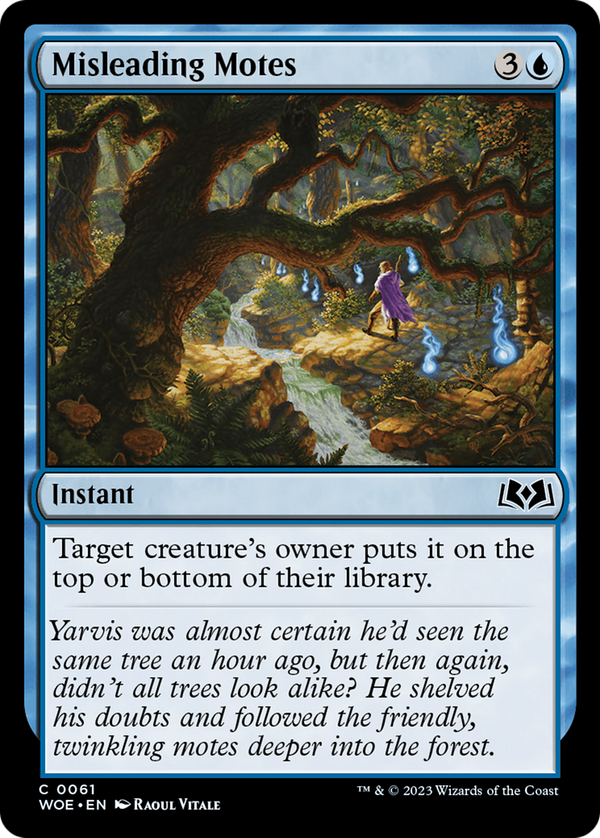
Misleading Motes


The choice clause hands the decision to the wrong side of the table, and that is the whole design. A return-to-hand spell like Unsummon or Vapor Snag gives back tempo immediately but keeps the caster in control of the outcome; here the creature's owner picks between the top and bottom of their own library, buying back a bomb or burying a liability on their own terms. That looks like a giveaway, and often it is, but there is a use the caster can steer. Point it at a creature the opponent cannot afford to redraw, and the owner is forced into their least-bad option: send it to the bottom and give up on seeing it again, or set it on top and clog their next draw with a card they would rather have replayed at once. It also works against threats that shrug off destruction: an indestructible creature that laughs at Doom Blade goes back into the deck instead, and tucking it costs the owner a full draw rather than handing the card straight back the way a bounce spell would. The blue-tempo lineage runs through those cheap unsummon effects that trade mana for a swing without permanently answering anything; this one pays more and surrenders speed for the tuck wrinkle. That trade rarely wins a race, which is why it reads more as disruption than tempo: a way to deny a specific draw, priced for the flexibility rather than the efficiency.