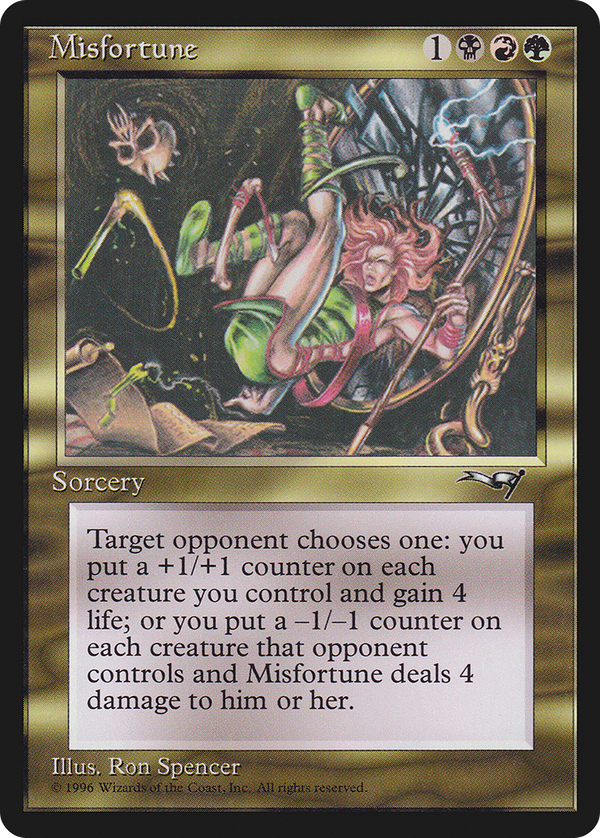
Misfortune




A punisher card, and a stark early example of the genre: two hardcoded modes, the opponent picks one, and your job is to build a board state where both picks hurt them. The design discipline is in the asymmetry the modes create. One clause grows your whole team and gains you four life; the other shrinks the opponent's team and burns them for four. Because the opponent chooses, the card never resolves the way you would freely pick. They will always take the line that helps you least, which means the real work happens before you cast it. Cast it when you are ahead on the battlefield with the bigger board, and the opponent is stuck choosing between watching your army get larger or watching their own wither while they take four to the face: two ways of losing the race they were already losing. Cast it when you are behind, and they will happily hand you four life and counters on creatures you do not have, declining to weaken the board that is beating you. The card rewards a winning position rather than rescuing a losing one, the opposite of what a four-damage swing usually implies. The three-color cost confines it to decks already committed to black, red, and green at once, which was a genuine deckbuilding tax in its era. It belongs to a recurring strain of design Magic returns to: routing the choice to the opponent so a card can carry two strong modes, with "they pick the one that hurts you less" standing in for a printed drawback.