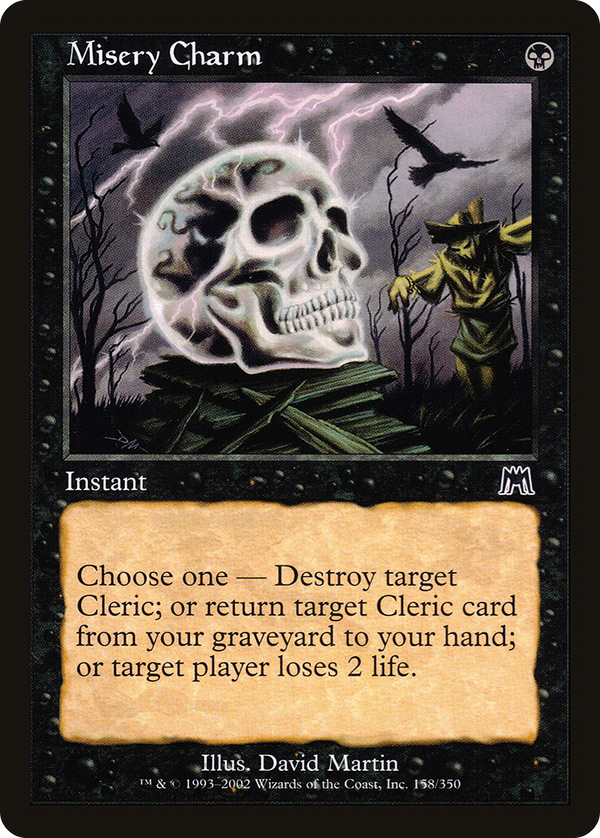
Misery Charm

Only one of the three modes here demands a Cleric in play: destroying one. The recursion clause reaches into your own graveyard for a fallen Cleric, and the third mode asks for nothing at all. That tells you who the charm was built for: the tribal lineage that put Cleric synergies on the marquee, where removal and recursion are the levers a focused deck wants against its own kind. But the two-life-loss mode is why the card never strands you. It fires at instant speed with no creature required, no condition attached, a clean line of black reach that any deck can run to close out the last points of a race or pick off a player sitting at two. That single clause converts a narrow tribal piece into a universally castable one. The design logic is the whole appeal of the cycle it belongs to: each mode is too specific to justify a card alone, but the bundle guarantees the spell is live in every hand. You cast it for the drain and treat the Cleric clauses as a bonus the matchup occasionally hands you. The floor is a playable burn-adjacent effect; the ceiling is a one-mana modal answer inside the deck it was printed to reward, where flexibility, not raw power, is the point.