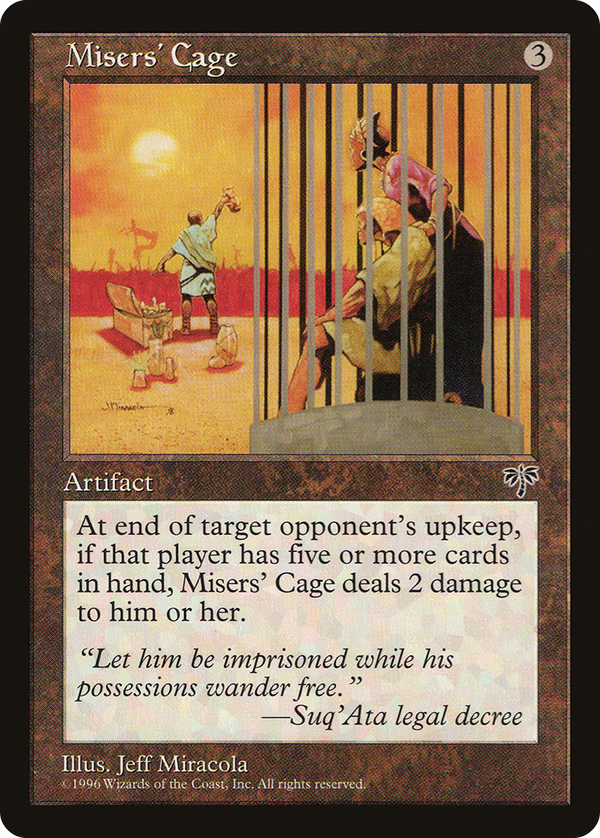
Misers' Cage

A punishment card built backwards: instead of rewarding the controller for keeping a full grip, it taxes the opponent for holding one. The threshold of five cards is the design's whole hinge, because it sits exactly at the resting hand size a defensive deck wants to maintain. The artifact does not force a discard or empty the hand; it simply makes hoarding cost 2 damage per upkeep, converting the opponent's card advantage into a clock that ticks at their own pace. That is the inversion worth noting: a control player's instinct is to bank answers and play reactively, and this asks them to spend cards faster than they would like or take the damage for the privilege. Two damage is small in isolation, but it repeats every turn a hand refuses to deflate, and it draws on the same strategic axis that hand-disruption pursues from the opposite direction: where discard removes the cards, this raises the rent on keeping them. It belongs to a narrow family of incidental hate pieces from the era that tried to give aggressive decks a way to close against the inevitability of a fuller hand. The friction is real but modest, which is why its value scales directly with how stubbornly an opponent wants to sit behind cards they refuse to deploy: against a deck that empties its hand by instinct it does nothing, and against a deck that hoards it becomes a slow, self-inflicted bleed the opponent has to actively dismantle.