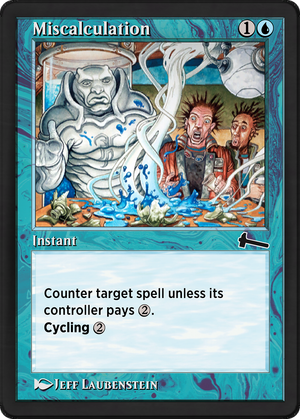
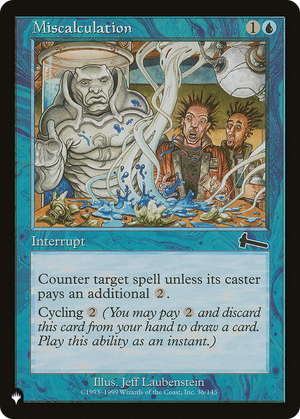
Miscalculation


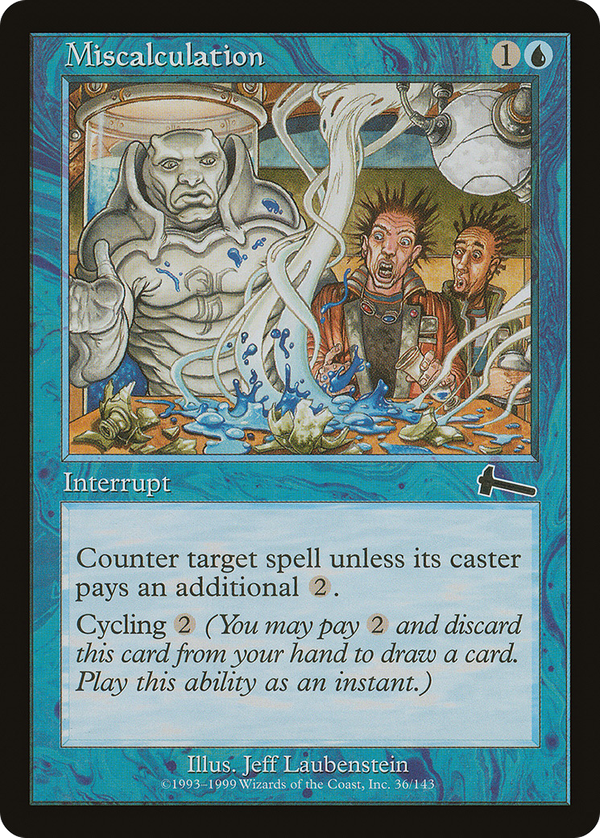
Force Spike with an escape hatch is the cleanest way to describe the design tension here, but it undersells the engineering. The counter half is a soft tax that only bites in the early game, when two mana is real money and the opponent cannot spare it; cast it on the second turn and you have likely stopped something, cast it eight turns deep and you have wasted a card. That decay defines the spell, and the cycling clause is what redeems it. Every soft counter before this carried the same liability: hold it too long and it rots in hand as a dead card. The  cycling cost lets you cash the spell for a fresh draw the moment the window closes, which means it almost never sits useless. The result is a counter that is never quite a blank, the floor raised from "embarrassing topdeck" to "replaces itself." That hybrid of conditional interaction and guaranteed card-velocity became the template the design language returned to repeatedly: a marginal effect stapled to cycling so the worst case is a cantrip. The card reads simple, but it solved a structural problem with permission spells (the dead-late-game tax) by routing around it rather than buffing the tax itself.
Rules text
.
Cycling (, Discard this card: Draw a card.)