Mirror Universe

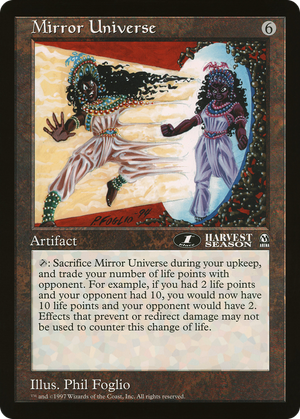
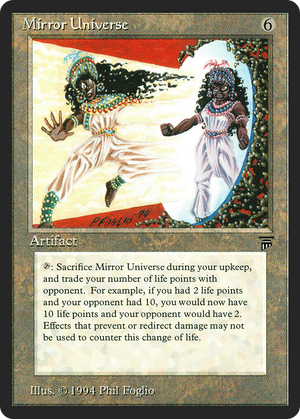
Richard Garfield's purest expression of the "swap a resource you don't want for one your opponent does" school of design, and the most violent one ever printed. The card treats life as a tradeable commodity rather than a clock, which was a heretical reading in 1994 and is still the framing that makes the card interesting. The upkeep restriction is what keeps it honest: you cannot crack it in response to a lethal attack, so the sequencing burden falls on you to arrive at your own turn with a life total low enough to weaponize and a board state stable enough to survive having traded into your opponent's higher one. That constraint turned the card into the keystone of a specific combo lineage built around getting to one life on purpose: paired most famously with Fire Covenant and later with the various Lich-style effects that decouple life from loss conditions, the card stops being a desperation button and becomes a wincon. The self-sacrifice makes the effect one-shot by construction, which is why every deck that has ever wanted it has wanted a tutor for it more than a second copy. A piece of design vocabulary the game has circled back to (Soul Conduit is the cleaner modern rewrite) without ever quite matching the menace of the original's upkeep-only window.
Rules text
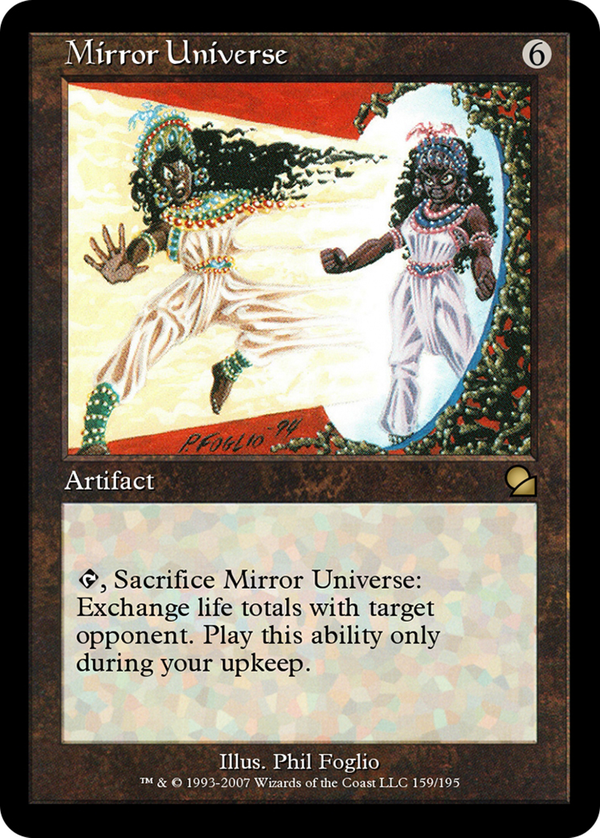
 , Sacrifice this artifact: Exchange life totals with target opponent. Activate only during your upkeep.