Mirari

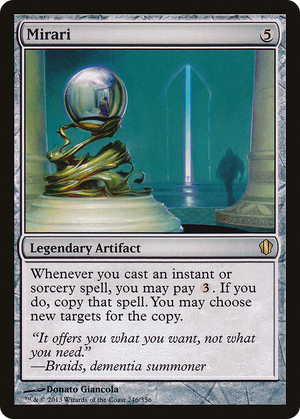
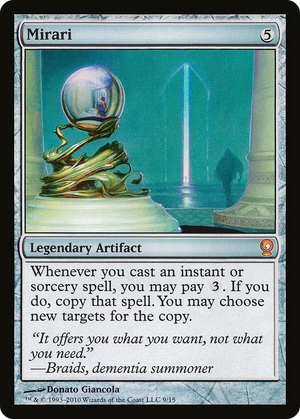
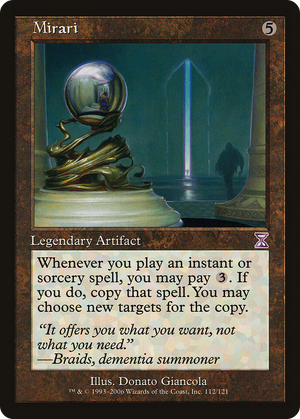
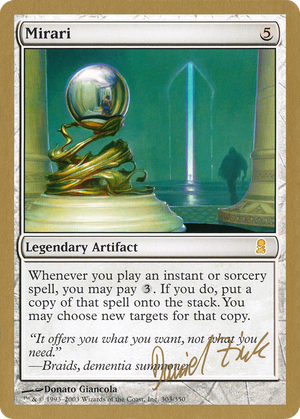
The artifact that turned every cantrip into a question of how much mana you had left over. Five to deploy, three per spell to fork, and suddenly your removal kills two things, your draw spell draws four, your kill condition kills twice. What keeps it from breaking a deck on its own is that it taxes itself honestly: the copy is optional and paid for each time, so the math only tips in your favor when the underlying spell already justified its cost. You pay full freight for every duplication, which is why it anchored the slow, spell-heavy decks of its era rather than becoming a degenerate engine. The copy chooses new targets, so a single burn spell becomes a split and a draw spell becomes a refill; the value scales with how flexible your spellbook is rather than how powerful any one card happens to be. That is a patience tax as much as a mana tax, rewarding a deck that wants to win by casting good spells slightly better than the opponent can. Its flavor weight outran its play, too. The Mirari became the literal MacGuffin of an entire block, the object every faction chased, and its name carried into Mirari's Wake, an enchantment whose untap-and-double mana doubling reads as the artifact's power leaking sideways into the land.
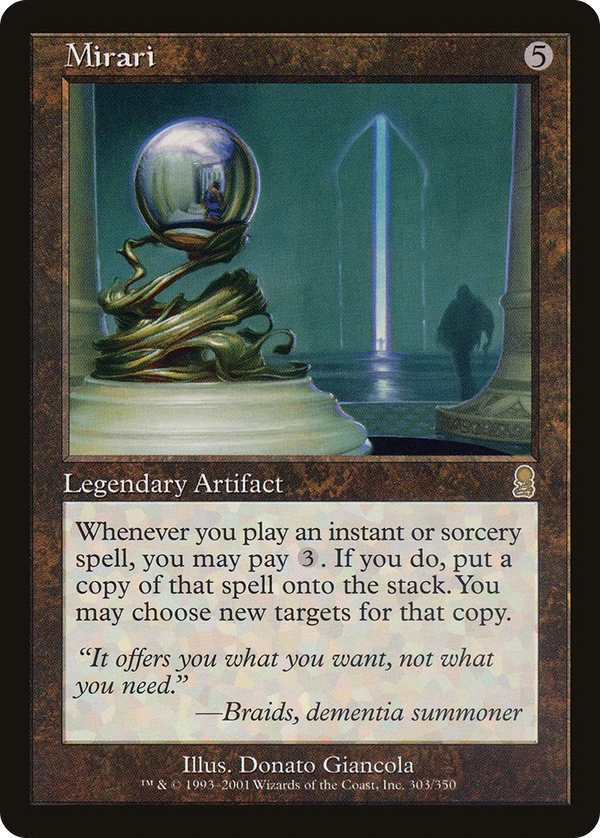
Rules text
 . If you do, copy that spell. You may choose new targets for the copy.