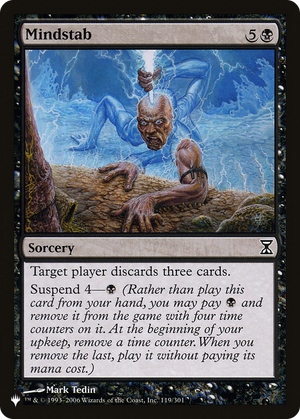
Mindstab


The hard part of discard was never the effect; it was the tax. Three cards out of an opponent's hand is a brutal swing, but black has rarely been allowed to pay a fair price for it, which is why this lands at six mana, a rate nobody would seriously consider casting from hand. Suspend is the loophole that makes the bill payable. For a single black mana, you exile it with four time counters and agree to wait, turning a prohibitively expensive sorcery into the cheapest possible commitment now and a guaranteed discard four upkeeps later. The design lives entirely in that trade between tempo and certainty: you announce the threat on turn one, telegraphing exactly when the hand-stripping arrives, and your opponent gets four turns to empty their hand before the counters run out. That telegraph is the cost. Where most discard wants to fire early and catch a full grip, this one warns the table it is coming, inverting the usual logic of the effect: the suspend line is best when you can deploy it early enough that an opponent has no time to refill, and worthless once they have dumped their hand onto the board. It is discard repriced as a clock, a card whose worth is decided not by its mana cost but by how the four counters align against everything else unfolding around them.
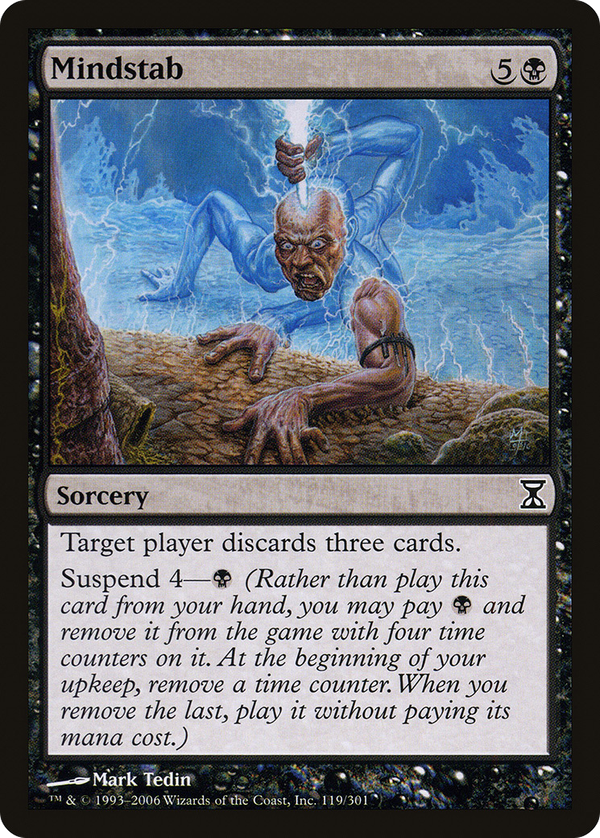
Rules text
(Rather than cast this card from your hand, you may pay and exile it with four time counters on it. At the beginning of your upkeep, remove a time counter. When the last is removed, you may cast it without paying its mana cost.)