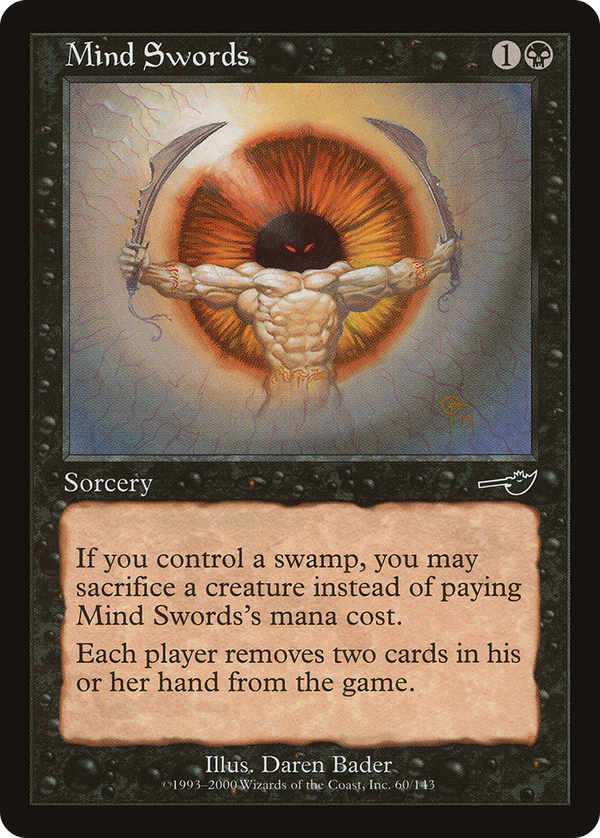
Mind Swords


Symmetric hand attack was already an old idea by the time this printed: both players strip cards, both feel the squeeze, and the game has always been about bending that symmetry into a one-sided wreck. The mana-or-sacrifice clause is the bend. Pay two mana and you have a fair-ish disruption spell that costs you as much as your opponent. But if you control a Swamp, you can feed it a creature instead, something you were already done with (a chump blocker, a tapped attacker, a spent token), and pry two cards from each hand for no mana at all. The winning line writes itself: empty your own hand first, then cast this when theirs is full, and the mirror inverts into pure one-sided denial. The exile, not discard, sharpens it: the cards leave the game outright, so neither player gets to mine the loss for graveyard value.
That sacrifice line is what stops the free version from being actually free. It demands a Swamp on the board and a creature you can spare, paying in color commitment and board presence rather than mana. Pitch-Black creature sacrifice as a casting cost was a recurring early-era idea, tethering disruption to a graveyard-and-bodies texture instead of raw efficiency. Cast on curve, it reads as an even trade; cast after you have hollowed out your own hand by design, it reads as a haymaker.