Midsummer Revel


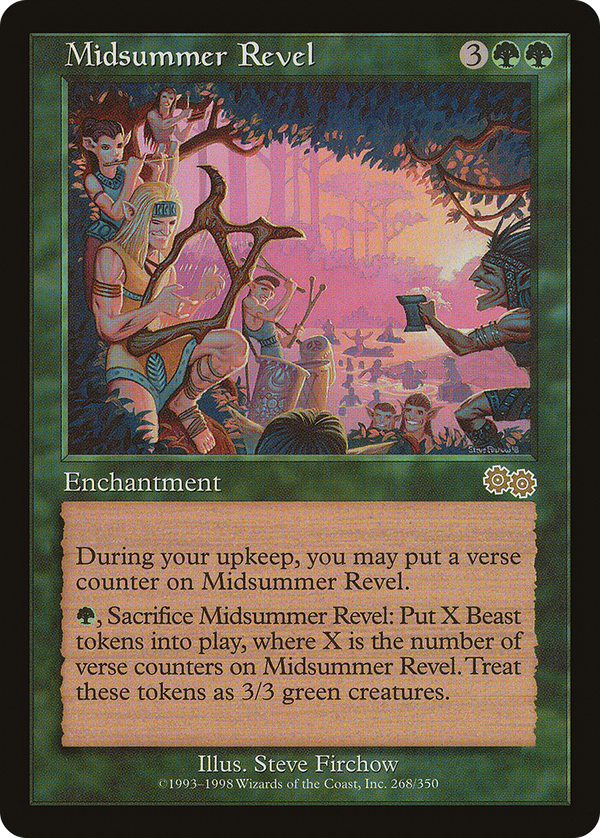
The bargain here is patience for size, paid in counters and the constant threat of removal. Each upkeep adds an optional verse counter, and the payoff scales linearly: sacrifice it for X 3/3 Beasts, where X is whatever you have managed to accumulate. The design lives entirely in the tension between those two halves. Leave it on the battlefield to grow and you hand your opponent a window: an enchantment with no immediate effect is an obvious target for disenchant effects, and every turn it sits there is a turn your investment is exposed. Cash it early and the army is small. The verse-counter mechanic was the connective tissue of this set's enchantment cycle, a slow-burn engine philosophy that asked you to commit mana and time up front for a delayed, escalating return. Midsummer Revel is the most aggressive expression of that idea: not card advantage, not a recurring trigger, but a single explosive turn that can end a game if it survives long enough. The sacrifice cost is almost nothing, which tells you where the real cost lives. It is not the activation; it is the waiting, and the cards your opponent draws while you do it. A green deck that resolves this and protects it for four or five turns wins on the spot. The trick, as the card knows full well, is surviving the part where you do nothing.
Rules text
, Sacrifice this enchantment: Create X 3/3 green Beast creature tokens, where X is the number of verse counters on this enchantment.