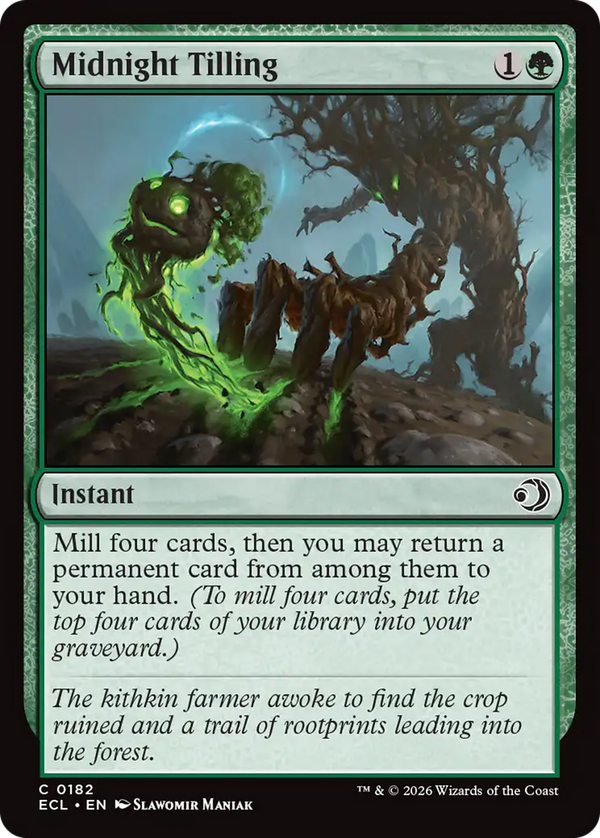
Midnight Tilling


Green's answer to card advantage has always run through the graveyard sideways: you dig, you accept that some of what you turn up is lost. What sets this apart is the return clause narrows to permanents, so the mill is not attrition but a filtered draw. You flip four, keep the best land, creature, artifact, enchantment, planeswalker, or battle among them, and let the nonpermanent cards fall to the yard. That permanent-card restriction is the honest price: hit a pocket of instants and sorceries off the top and the return whiffs, giving you four cards in the bin and nothing back to hand, while a deck stuffed with permanents treats it as a cheap dig that also stocks a graveyard. The instant speed matters more than the effect suggests. Casting it during an opponent's end step lets you bury four to fuel a delve, escape, or reanimation payoff on your own turn, dodging the sorcery-speed vulnerability that similar self-mill effects carry, and you can hold the mana up as a bluff for interaction until then. It reads as a cantrip and plays as a bridge between two green subgames: the fair one, where you dig for your next land drop or threat, and the graveyard one, where the four cards in the bin are the actual reward and the returned permanent is a bonus. Which half you are playing depends entirely on the deck around it, and the card is built to serve both without committing to either.