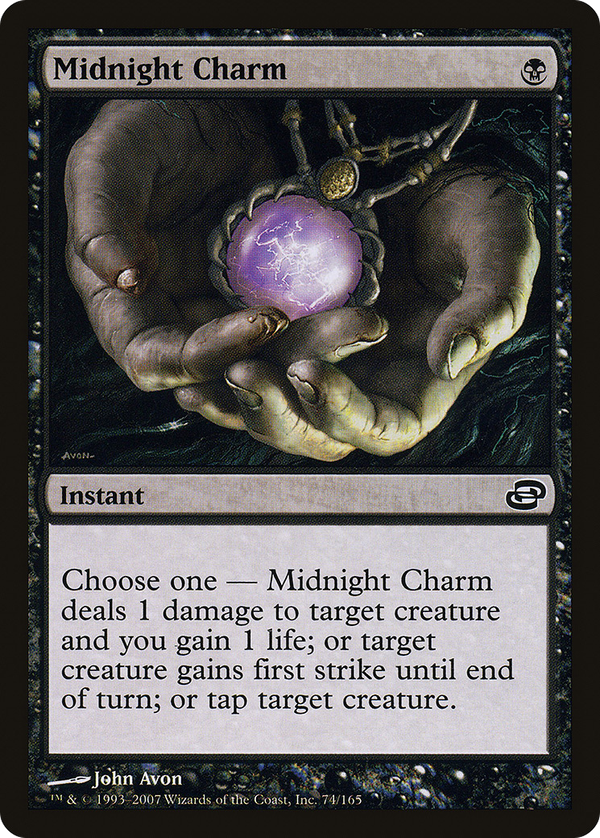
Midnight Charm

The point of interest is the recoloring: this is the black member of a charm family whose modes were deliberately handed to colors that would not normally own them, and what black received is white's combat toolkit translated into a single-pip instant. The damage-and-lifegain line reads as black's small-ball drain, the one effect here that sits squarely in color. The other two lines are the trespass. Tapping a potential blocker or attacker before it is declared shapes combat the way white tempo does, keeping a creature out of the coming fight; granting first strike is the kind of combat-skewing trick white usually keeps to itself, turning an even trade in your favor or letting a defender deal its damage before the attacker can swing back. The design discipline is the one-mode-per-cast limit: you choose which lever combat needs this turn and pay for none of the others, so the flexibility never compounds into a single overloaded answer. That is the whole bargain. Each mode does only a little, the choice is locked the moment you cast, and the card resolves into the graveyard having pulled exactly one of its three strings. It works best as a study in how a fixed modal chassis behaves once the colors are rotated off-axis: first strike and the tap-to-blank line would normally be white's, the drain black's, and this collapses all three into one hand at the lowest cost the color pie will price them at.