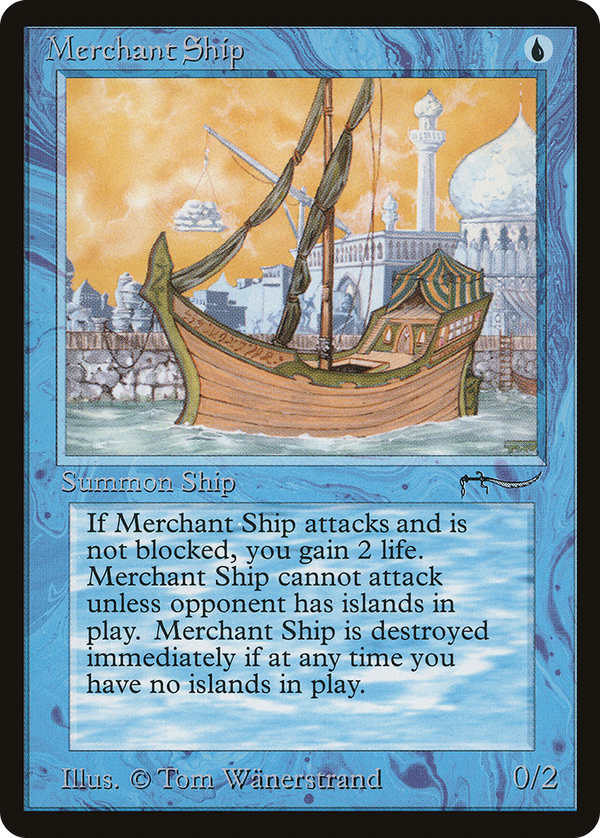
Merchant Ship

Few cards from the game's first year wear their flavor as openly on their rules text. The asymmetric attack restriction (it can only swing at a player who controls an Island) and the self-sacrifice clause (lose your own Islands, lose your ship) together encode an entire naval metaphor: a vessel that only sails where there is sea, and sinks the moment it has no harbor. This was the era when Wizards solved flavor problems by writing them directly onto the card, before notions like landwalk and landhome had been factored out into clean keyword templating. The curiosity is the upside clause: a one-mana 0/2 that gains you two life every time it attacks and goes unblocked. There is no evasion here, so the trigger depends on an opponent who declines to throw a blocker in front of a body that does nothing in combat anyway; against a control deck unwilling to spend a creature on it, the life simply accrues, two at a time, while the ship deals zero damage. Note the timing, too: the ability fires when blockers are declared and the ship is confirmed unblocked, not as combat damage resolves, so it is a triggered ability rather than anything tied to the damage step. The whole package is unrepeatable now; modern design would never bundle a conditional attack clause, an attacks-unblocked trigger, and a triggered sacrifice onto a common. It is a fossil from the period when a single card could be three different rules problems at once and nobody minded.