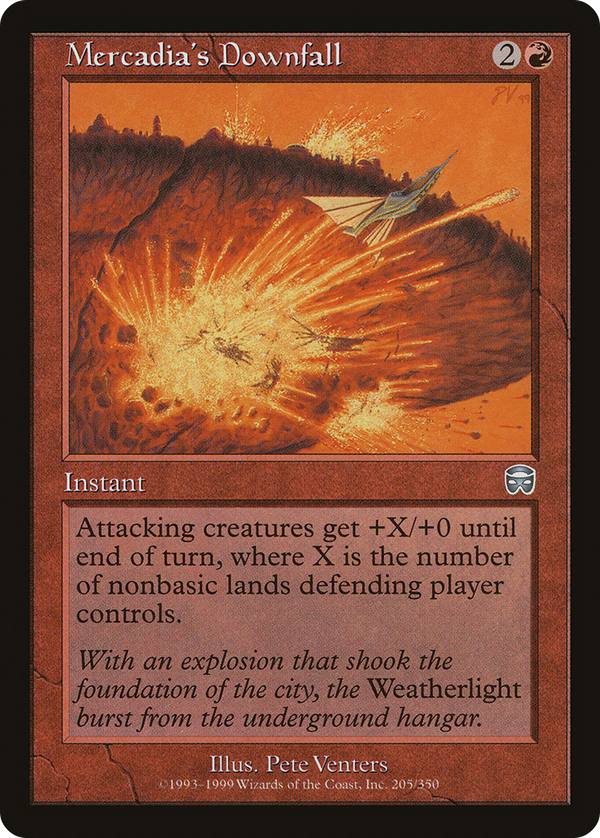
Mercadia's Downfall


The damage isn't on the card; it's in your opponent's manabase. Every attacking creature swings harder for each nonbasic land the defender controls, which means the pump you draw is a number you cannot quote until you see who you are fighting. Against a deck leaning on dual lands, utility lands, and fixing, the swing turns lethal in a hurry; against clean basic-land aggro it does nothing at all. That asymmetry is the whole reason to run it: the spell quietly taxes greed in deckbuilding, arming the attacker in proportion to how much the defender bent their lands toward power and consistency. The instant-speed window is where it earns its keep. Held until the attack step and cast after blocks are declared, it rewrites the defender's block math under them, turning a clean trade into a player walking into more damage than they signed up for. A fixed combat trick asks whether plus-two is enough; this one asks how greedy the opponent is and converts the answer straight into points. Its power was a referendum on the format's lands rather than on its own line of text, an early-era kind of design where an effect could only function in an environment deliberately built to carry it: blank in the wrong room and savage in the right one.