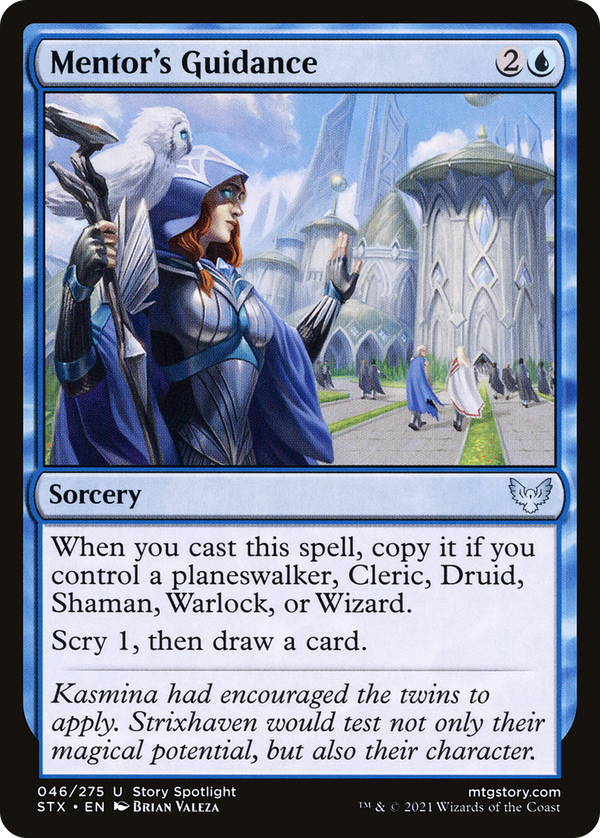
Mentor's Guidance


The entire design pivots on the caster-type check. A base cantrip with a scry stapled on is unremarkable smoothing; the copy clause is what turns it into a two-card dig, and it pays out on conditions many decks meet without building toward them. Notice the breadth of the trigger: planeswalkers plus five spellcaster classes that span the color pie. Wizard is the one blue plays with reliably, since a large share of playable blue creatures carry the type without trying, but the rest widen the net for any deck already leaning on Clerics, Druids, Shamans, or Warlocks in their heavier colors. That framing is the point. Rather than gating the reward behind a narrow build-around, the design gates it behind creature types a caster deck was likely running anyway, so it functions as a strict cantrip to anyone who ignores it and a genuine two-for-one to anyone tracking their board's typal lines. The copy resolves as a separate instance, so you scry and draw twice, sequencing each look independently rather than committing to a single peek before you know what the first card gave you. It is a quiet lesson in how conditional card advantage gets priced: the effect that would be overcosted without a rider becomes fair when the payout only lands for decks already invested in the trigger's fine print.