Memory Vessel


The symmetry is the trick, and the asymmetry is the payoff. Each player exiles seven and plays from that pile instead of their hand until your next turn: on paper an even trade, in practice a knowledge advantage that belongs entirely to whoever pulled the lever. You know your seven, you know they lock your opponents out of a hand they were counting on, and you know precisely when the window closes. This is red doing something red almost never does, which is manipulate cards from the top of everyone's library at once, a wheel-adjacent effect wearing an artifact's clothes and paid for with a red-heavy cost and a one-shot exile of the artifact itself. That last clause is the discipline: this is a single detonation, not an engine. You get one turn cycle where hands are frozen and libraries are showing their tops, and you build the rest of the deck to make sure your seven cards do more with that turn than any opponent's seven can. The sorcery-speed restriction keeps it from becoming an instant-speed hand-swap ambush, so the whole thing resolves on your main phase, on your terms, with your read of the board already made. It rewards decks that can dump a hand fast or convert exiled cards into immediate pressure, and it punishes anyone leaning on cards they've been holding back.
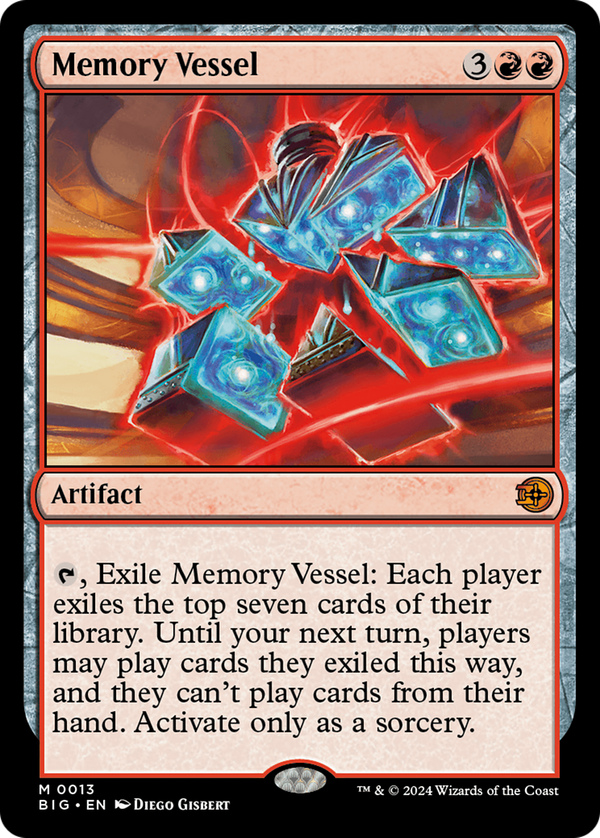
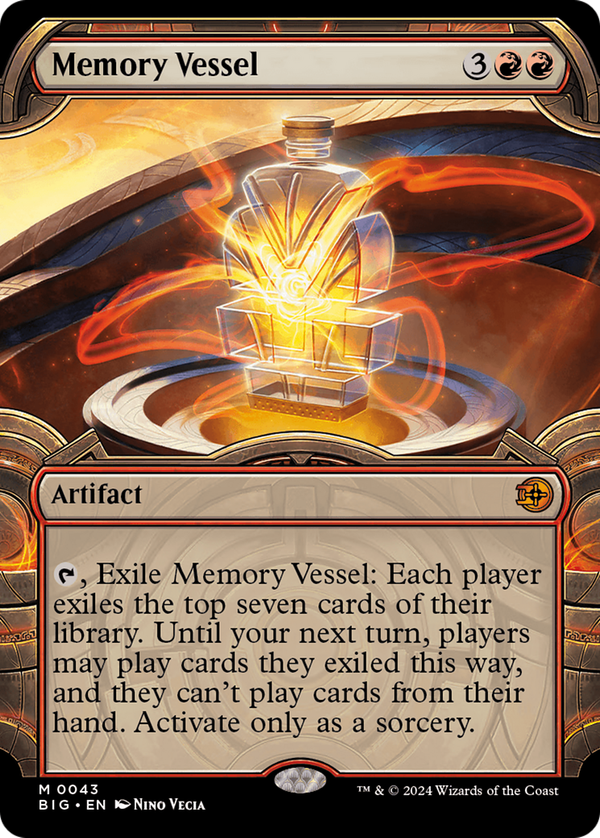
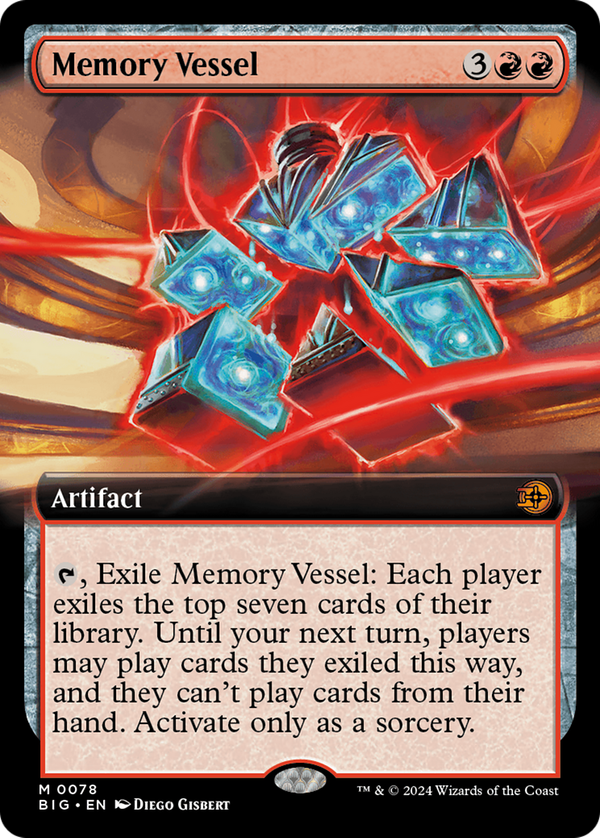
Rules text
 , Exile this artifact: Each player exiles the top seven cards of their library. Until your next turn, players may play cards they exiled this way, and they can't play cards from their hand. Activate only as a sorcery.