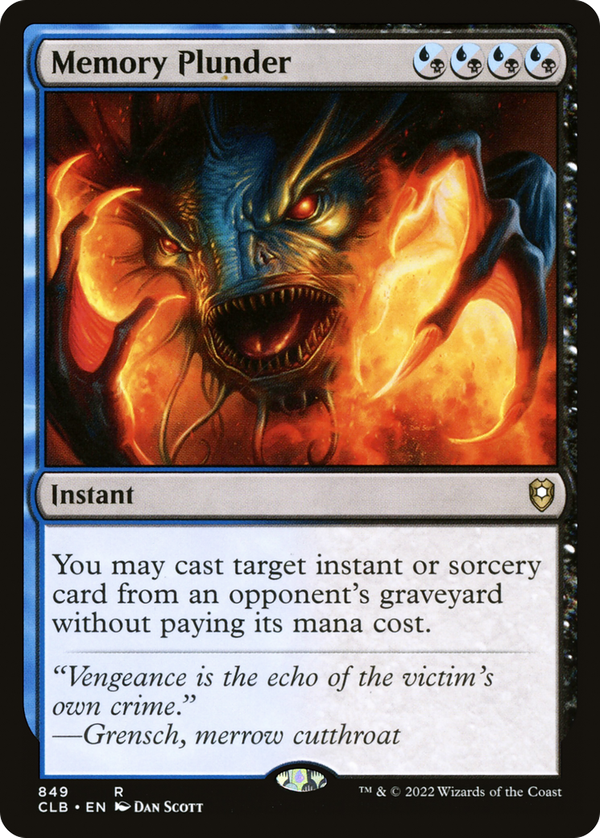
Memory Plunder

The payoff lives entirely in someone else's bin: the question is not what you have, but what your opponent has thrown away. That makes this reactive in the deepest sense, its ceiling set by spent cards rather than your own. Against a graveyard full of cantrips it stalls; against a control mirror where the yard holds a sweeper or a backbreaking finisher, it reads like a heist. The hybrid casting cost frees any blue or black deck to run it, mono-colored or split, so the only real deckbuilding tension is finding room in a reactive shell for a spell that does nothing until the opponent has done the work of stocking the yard. Instant speed dictates the line: hold it through their turn, let them resolve their best spell into the graveyard, then turn it around on the crack-back. Where many graveyard thieves widen the pool to any card type, this one stays disciplined to instants and sorceries, the two types that decide a removal-and-counters game. The four-pip commitment ties up mana a reactive deck wants to leave open anyway, so the cost rarely conflicts with how the deck already wants to operate. The reward, when it lands, is the rare reversal where the most dangerous spell in the game gets cast twice in a row, the second casting aimed back at the player who cast it first.