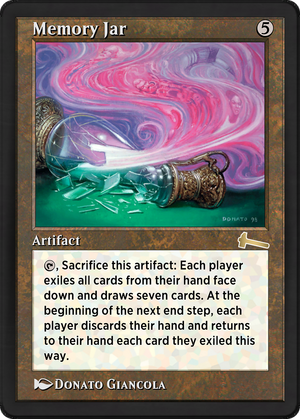
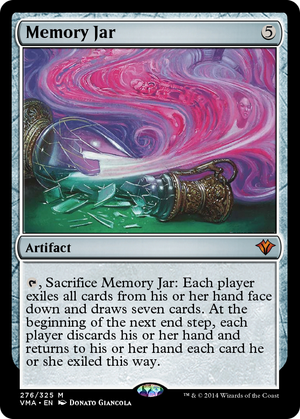
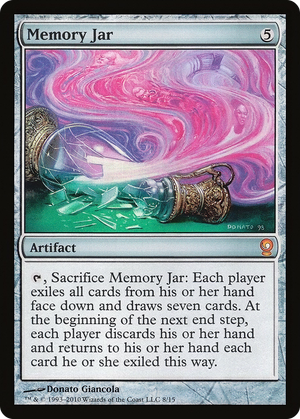
Memory Jar

The face-down exile clause is the entire design, and it is what turned a clumsy "everyone draws seven" symmetrical wheel into a one-sided engine the moment someone figured out how to break the symmetry. The trick is the discard step: at the next end step, each player's old hand comes back and the fresh seven gets thrown away. So the cards you draw are only yours until the turn ends, which means the artifact rewards a player who can convert seven cards into a kill or a lock before that window closes. In a deck stocked with cheap mana rocks and a way to recur the Jar, a single activation became the first link in a chain rather than a fair refill. That is why it lasted less than three months in Standard before being banned: the combo-fuel reading of the card outran its intended use as an expensive parity-breaker, and it has carried restrictions in older formats ever since. The temporary nature of the draw, the thing that was supposed to make seven cards safe to hand the opponent, is exactly the seam that storm-style decks pried open: you were never meant to keep the cards, only to spend them all in the same turn.
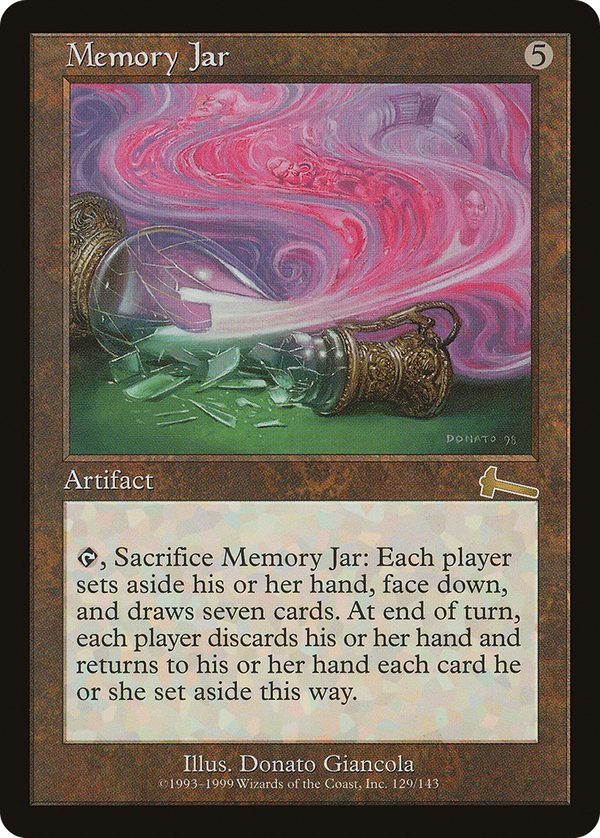
Rules text
 , Sacrifice this artifact: Each player exiles all cards from their hand face down and draws seven cards. At the beginning of the next end step, each player discards their hand and returns to their hand each card they exiled this way.