Megatherium


The math is the whole card: a 4/4 trampler for three mana whose entry tax scales with the worst thing you can be holding, namely cards. To keep the body on the battlefield you front-load your hand onto the table, paying one extra mana per card before the sacrifice clause resolves. That inverts the usual relationship between a full grip and a strong board. Most green decks want to hold gas; this one punishes you for it, asking that you empty out first and only then commit the threat. The clean line is to cast it when your hand is nearly spent, which is exactly the turn most aggressive decks reach naturally. So the design quietly rewards the curve-out rather than the value pile: dump your cheap spells, then land the body when the tax is one or two mana instead of five. It is an early stab at a tension that recurs throughout the game's design history, the hellbent axis where an empty hand is an asset rather than a liability, here expressed through a downside trigger instead of an explicit reward. The trample is almost incidental on a Beast this size, but it does the small job of making the 4/4 matter once it sticks. As a piece of mechanical archaeology it is more interesting than it ever was as a creature: a measured-by-hand-size cost on a body that wants you to play fast and play out.
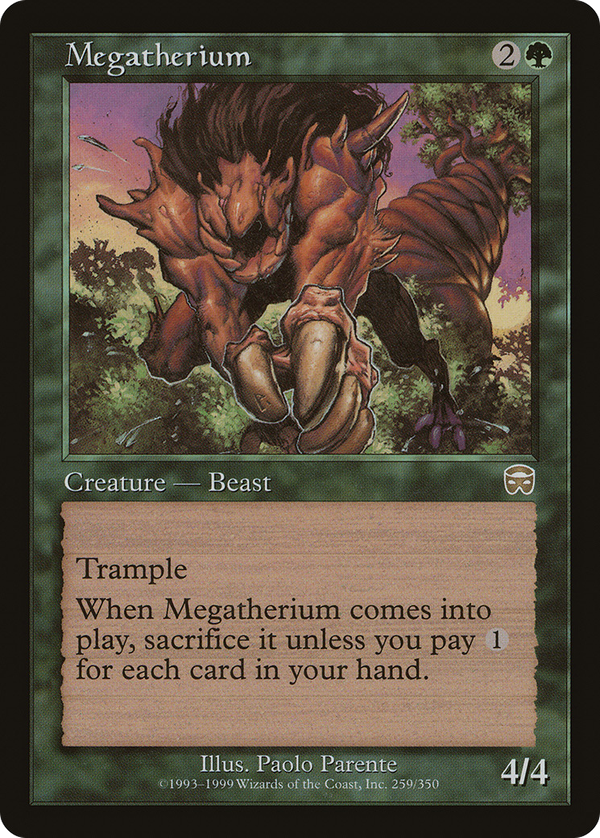
Rules text
 for each card in your hand.