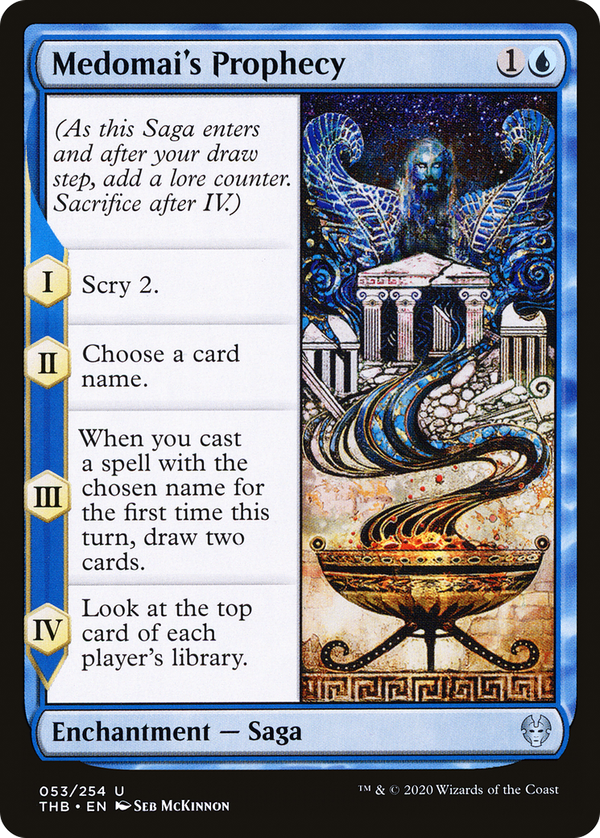
Medomai's Prophecy


The clever part of this Saga is that Chapter II is not a prediction; it is a piece of information management. You name a card you already hold, and the payoff on Chapter III is a matter of sequencing rather than luck: hold the named spell one turn, cast it on the next, collect two cards. The complication is that the clock is fixed and public. Naming a card commits you to a plan a full turn before you can execute it, and the payoff window is a single spell cast on a single turn, so an opponent who reads the board can play around the draw before it happens. The lore counters meter the value out on a schedule you cannot accelerate: Chapter I smooths the intervening draws with scry 2 while you decide, Chapter II locks in the name, and the payoff only arrives on the enchantment's own timeline. Chapter IV, which lets you peek at the top card of each player's library, is a private parting glance rather than a payoff, and by then the enchantment sacrifices itself. The design turns card advantage into a telegraphed, time-released promise: you announce your intention, you wait, and you deliver on cue. It rewards a deck with a stable game plan and a hand it can hold together across turns, and gives nothing back to one improvising off the top.