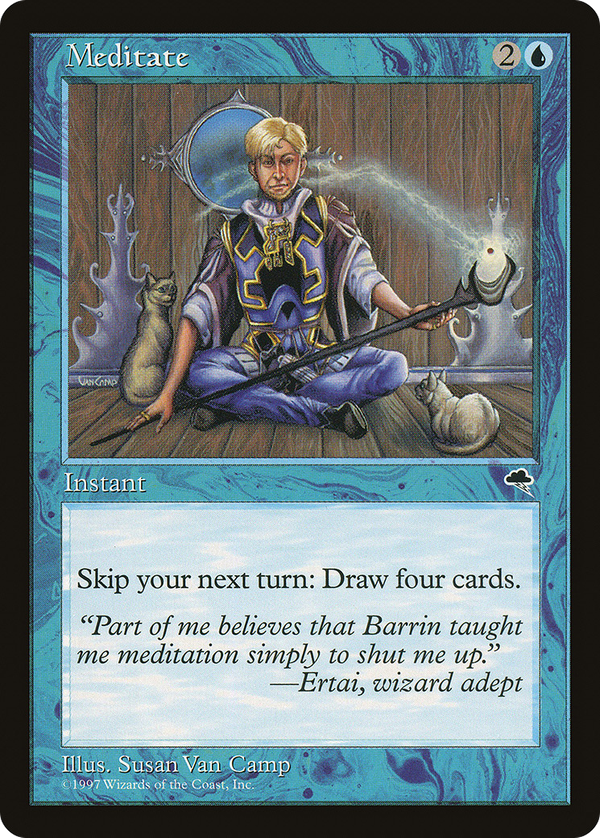
Meditate


Four cards now, a whole turn later: the cleanest expression of the "draw big, lose tempo" design that defined blue's relationship to card advantage in the late 1990s. The skipped turn is not a drawback bolted on to make a generous draw spell fair; it is the entire mechanical premise. You are mortgaging your next untap, draw step, and attack phase against a fistful of cards now, which means the cost does not scale: it hurts most when you are ahead and have a board to leave idle, and least when you are stalled and racing to find an answer. That inversion (worst when winning, best when desperate) is the friction the whole card runs on. The trap is timing it like a normal end-step draw spell: cast on an opponent's end step, Meditate hands them back-to-back turns, since the turn you skip is the one that should have followed theirs. In a fair game that is frequently lethal, which is precisely why the card never settled into midrange control shells. Its home is the deck that has no use for a next turn at all: combo and storm-adjacent builds that intend to win on the turn Meditate resolves, drawing into the kill before the skipped turn can ever cost them anything. The card asks one question of its pilot: do you actually need to untap again? If the answer is no, the cost is free, and four cards for three mana is one of blue's best rates.