Mathemagics


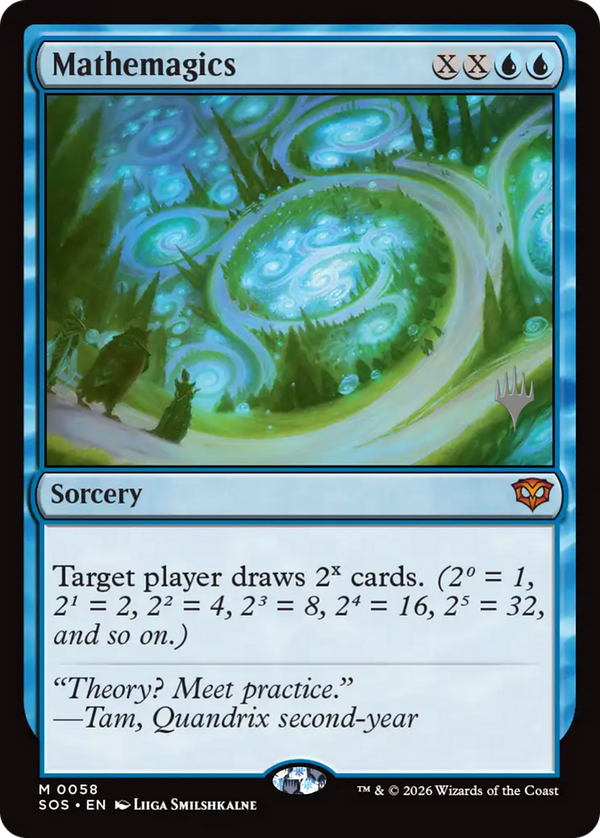
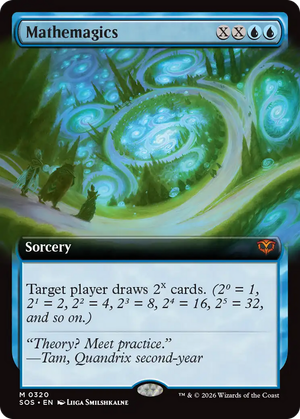
Card-draw spells have always priced their payoff linearly: pay more, draw more, roughly one-to-one. This one bends the curve into an exponent. The doubled X in the cost feeds a power-of-two payoff, so the mana you commit and the cards you get race up two different scales. Paying nothing draws a single card; paying enough to make X equal three, which costs six mana on top of the base, draws eight; push X to five and you are reaching for thirty-two cards. The design trick is that the mana cost climbs linearly (2X plus the two blue) while the reward doubles at every step, and past a certain point the reward outruns the cost so fast that the spell stops being a value engine and becomes a way to empty a library on purpose. The target clause makes that emptying flexible: the exponent can be pointed inward as a resource or aimed across the table as a mill kill, decking an opponent under a pile of forced draws. The oracle text spelling out the sequence (1, 2, 4, 8, 16, 32) is doing rules-legibility work for a mechanic Magic almost never uses; most cards that scale with X keep it linear precisely because exponential growth is hard to cost and easy to break. What lifts this above a splashy draw spell is that it forces the question every big-X spell dodges: how many cards is too many, and does drawing your whole deck win or lose you the game.