Martyr of Sands

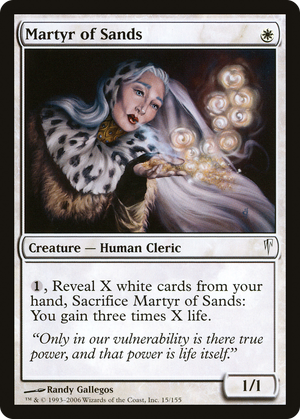
The lifegain engine that taught a generation of white players to count cards in hand, not creatures on board. The math is the whole engine: every white card you reveal converts to three life, and revealing rather than discarding means the same hand can fuel the activation turn after turn if you can recur the body. That recursion is the deck it was built for. Loop this Cleric back from the graveyard, reload your hand with white cards, and the life total climbs faster than any aggressive deck can outpace, turning a fragile body into a soft lock that buys the time a control or combo shell needs to assemble its real win. The design tension is honest about its cost: the life is enormous but you are spending card advantage to get it, sacrificing the creature and committing your hand to the reveal, so the payoff is gated behind a deck that treats a full white hand and a recursion package as a resource to be spent deliberately. The reason it became the backbone of dedicated lifegain prison strategies rather than a sideboard speed bump is that the life scales with hand size instead of a fixed number; the same activation that nets three early can net fifteen or more once the deck is assembled. A one-drop that gains three life is a footnote; one that gains fifteen and keeps doing it is a clock running in the wrong direction for everyone across the table.
Rules text
 , Reveal X white cards from your hand, Sacrifice this creature: You gain three times X life.