Martyr of Ashes

The sacrifice converts a hand's worth of red cards into a board wipe, and the conversion rate is the whole design. Each red card you reveal is one point of damage to every nonflyer, your own ground creatures included, so the ceiling scales with how committed your hand is to red. Crucially, you reveal those cards, you do not pitch them: the burn and creatures you show off stay in hand for the following turns, which means the activation costs you tempo and a board presence, not card advantage. That ground-only clause is the load-bearing part. It carves out an asymmetry for fliers and for the controlling deck willing to keep its threats in the air, turning what reads as a symmetrical sweep into a targeted answer against go-wide ground assaults. The body is incidental; it exists to be sacrificed, and the activation asks you to fire at the moment your hand is fullest of red and your opponent's ground is widest. Timing is the catch: reveal-and-sacrifice is a one-shot detonation, so you cannot hold it as ongoing insurance the way you would a repeatable pinger, and the  plus the loss of the shaman is real friction on a turn you would rather be developing. It is built for a deck that hoards cheap red spells and then cashes the unspent ones into a reset, an answer to the very ground-heavy mirrors that aggressive red decks tend to fear most.
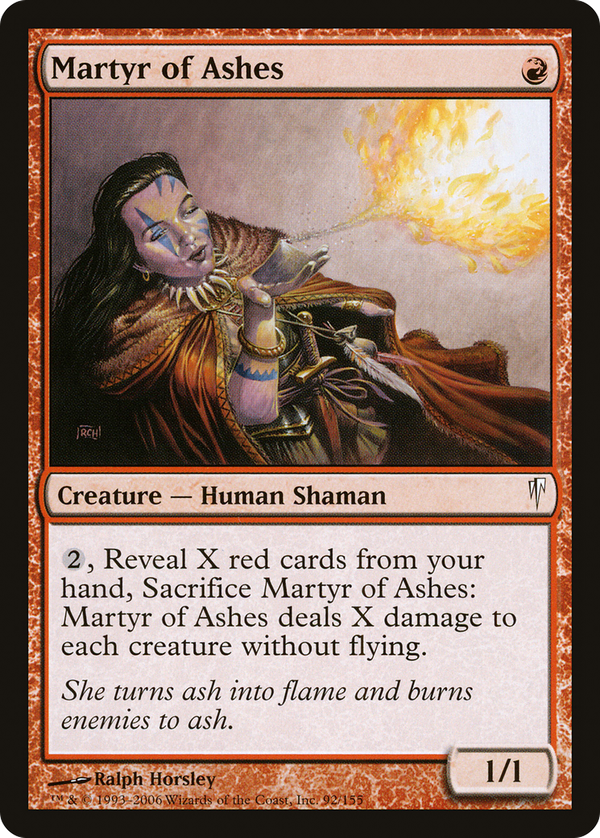
Rules text
, Reveal X red cards from your hand, Sacrifice this creature: This creature deals X damage to each creature without flying.