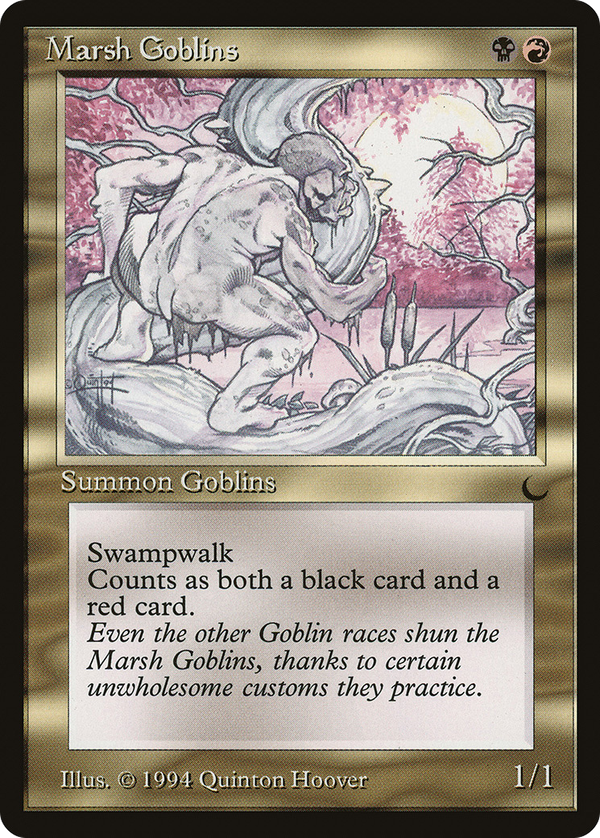
Marsh Goblins


A two-color body whose entire payoff is a single conditional evasion keyword, which tells you most of what early Magic thought a gold card should be: a small creature paying a steep cost for a narrow, situational upside. The math is unforgiving. You spend two colors of mana on a 1/1 that connects only against an opponent who happens to be on Swamps, and against an opponent who is not, you have a vanilla two-drop that cost two and asked for both black and red to cast it. Swampwalk is the operative tension here: it is binary, it is opponent-dependent, and the body never grows to compensate. Landwalk as a design idea was built on the assumption that you could read the metagame and tailor your evasion to the colors across the table, but that assumption gets weaker the more diverse the field becomes. What this card captures is a moment when the design language was still figuring out how to price multicolor and how to value evasion that only sometimes exists. The answer, in hindsight, was that pinning a creature's relevance to a land type the opponent may not even run leaves you holding a 1/1 with a hard casting requirement and nothing to show for it most games.