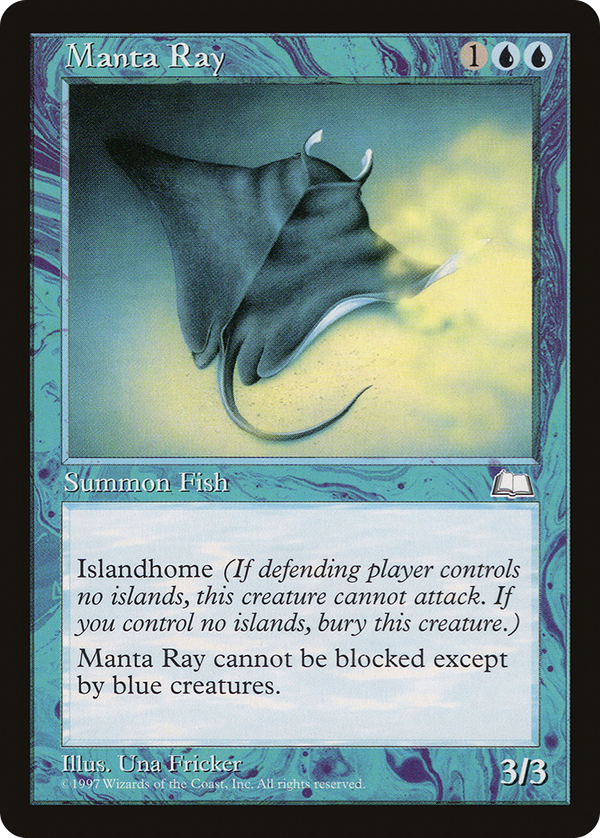
Manta Ray


Three abilities, each pointed at the question of who is playing blue, but not all pointed in the same direction. The attack restriction reaches across the table: this Fish stays home unless the defending player controls an Island. The evasion clause checks creatures, not lands, so it slips past anything that is not blue. And the sacrifice trigger swings the lens back onto its own controller, demanding you keep an Island in play or watch the creature die the moment your own Islands run out. The body is a respectable 3/3 for the cost, but the rules text traps it inside a matchup it can only win against an opponent who happens to share its color: a mirror-match beater that refuses to attack a player who has not committed to blue, while quietly insisting you commit to it yourself. This is landwalk's logic disassembled and reassembled into something stranger. Islandwalk grants clean evasion against blue and leaves it there; here the design splits the work into two static restrictions (an attack lock and a who-can-block clause) and a triggered self-destruct condition, each reading a slightly different slice of the board. The era that produced it was comfortable welding hyper-specific hate directly onto creature bodies, long before that kind of color-hosing migrated into sideboards and dedicated answer cards. What remains is a curiosity in the truest sense: a creature whose effectiveness is entirely contingent on the opponent cooperating by playing the exact archetype it was built to punish, and which politely removes itself from play when its own mana fails.