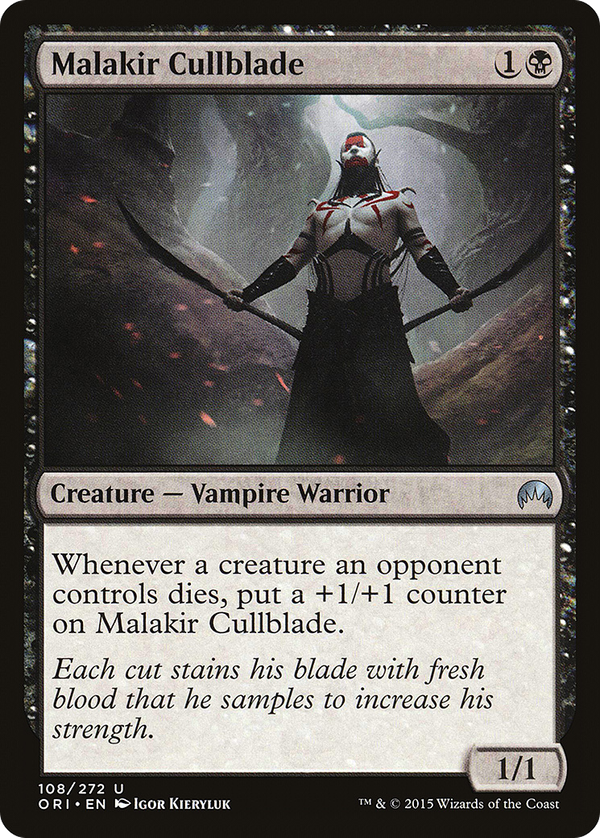
Malakir Cullblade


The growth here is parasitic in the literal sense: it feeds off the opponent's losses, not the controller's actions. A 1/1 for two that swells every time something on the other side dies is a card built for grindy, attrition-heavy boards where bodies trade constantly, and it punishes an opponent for the very thing that usually digs them out of a corner. That makes it a strange beast: it gets bigger fastest when you are also fighting back, since chump blocks, edicts, and removal all spend opposing creatures into its counter pile. The weakness is structural and unavoidable: an empty opposing board leaves it stalled, and against a single fat threat it stays a 1/1 forever. So it asks for a deck that manufactures opposing deaths on its own, sacrifice effects pointed at the opponent or a steady stream of small removal, rather than one that simply hopes the game gets bloody. Compared to creatures that grow off your own deaths or your own spells, the trigger condition is rarer and harder to control, which is the cost the cheap rate pays for. Counters stick permanently, so a Cullblade that survives a long game can outclass much pricier vampires, but getting there means surviving the early turns when it is still a fragile one-drop-sized body wearing a two-mana price tag.