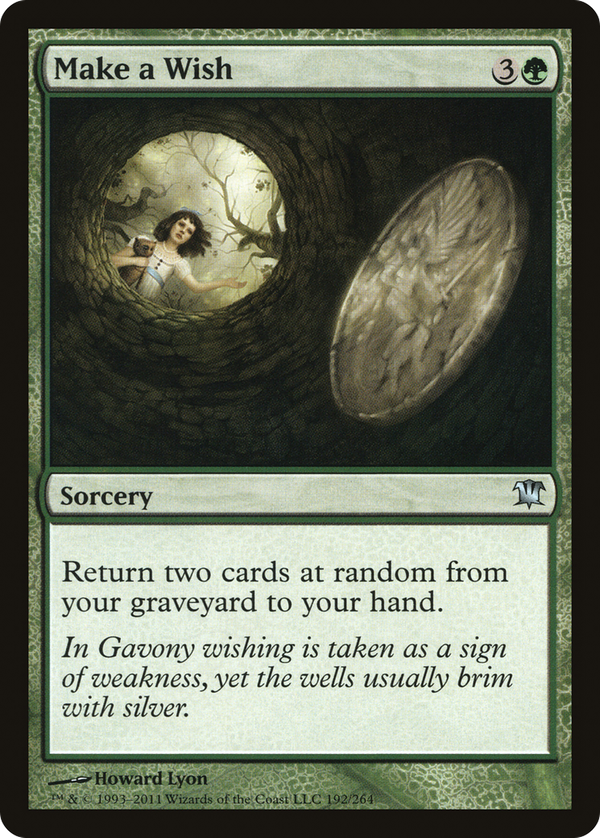
Make a Wish


The "at random" clause cuts against everything graveyard recursion usually promises. Most cards that return things from the yard let you pick: you reach for the exact threat, the missing combo piece, the answer you need this turn. This one converts four mana into raw card advantage but surrenders the selection that makes recursion powerful, handing the choice to a coin flip across whatever your graveyard happens to hold. That randomness is what justifies the volume; two cards back for four mana would be undercosted if you got to choose which two. The practical consequence is that the card wants a graveyard with no bad outcomes, where every card is roughly interchangeable in value, so that "two at random" approximates "two of my best." Build a deck thick with lands and dross and it punishes you; build one where the yard is uniformly stocked with playables and the randomness stops mattering. Green is the color most associated with precise, targeted recovery (Regrowth and its many descendants reach for a single named card), which is exactly what makes this design read as a deliberate inversion: it strips out the selection that defines the color's recursion and trades it for sheer quantity. It does not care what comes back, only how much.