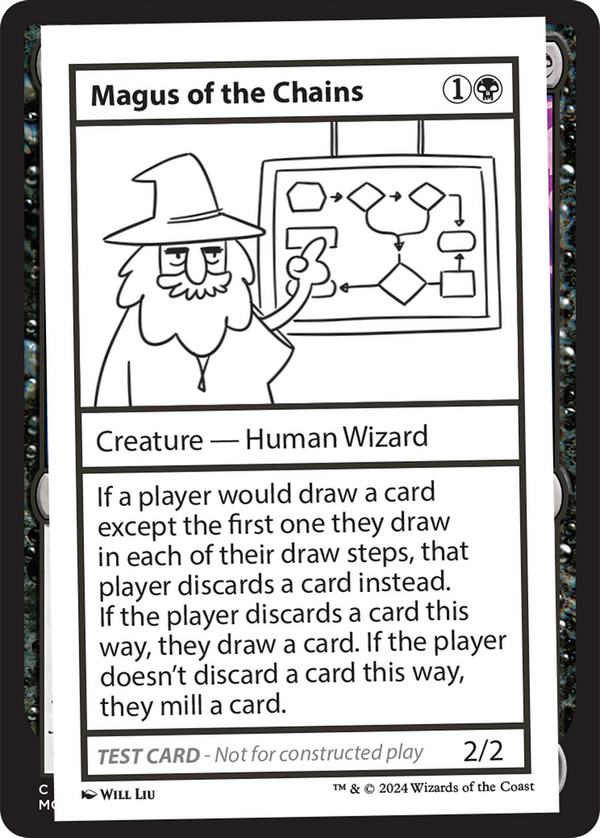
Magus of the Chains


The joke sits in the reading, not the effect: this is a loving homage to Chains of Mephistopheles, one of the most notoriously hard-to-parse cards ever printed, its dense conditional draw-replacement clause reborn as a paragraph that turns every draw after the first into a discard-then-draw-or-mill contraption. What actually happens is quieter than the sentence implies. Extra draws become loot effects that filter without changing hand size, and a player with nothing to pitch mills instead. So the effect punishes empty hands and rewards full ones, converting card-quantity engines into a churn of card selection and self-mill. The wrinkle is that it applies to every player, making it fully symmetrical: a table stacked with draw engines becomes a shared filtering-and-milling environment, while a hand-starved player just watches their library thin. Under the gag, the design is doing something genuinely underexplored: symmetrical draw replacement that trades raw card advantage for graveyard fuel and hand quality. Reservoir-of-cards builds and self-mill payoffs get a wide-angle enabler; anyone leaning on refill effects to rebuild a hand finds those refills quietly downgraded to loots. The 2/2 Wizard frame is incidental. The point is the parser-breaking wall of text, a design that dares you to track exactly which draw is the first one in each draw step, and to remember that the first draw each draw step is the one the clause pointedly leaves alone.