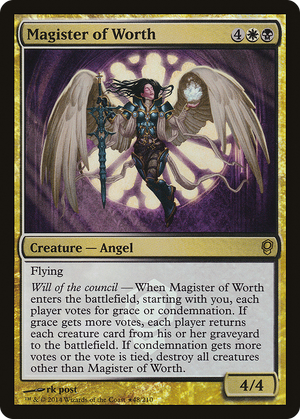
Magister of Worth



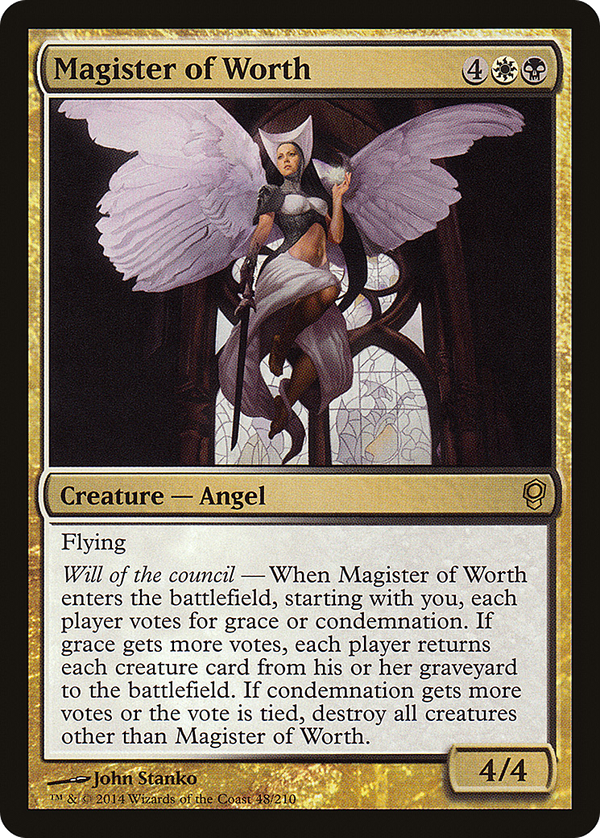
The vote turns a board wipe into a negotiation. Most mass removal resolves the same way every time: the controller pays the mana, the board dies, the math is fixed before the spell ever hits the stack. Will of the council breaks that determinism by handing the decision to the table, and the two outcomes are violently opposed. Condemnation is a near-total wrath, sparing only this Angel itself; even the controller's other creatures burn. Grace is the inverse: every player returns each creature card from their own graveyard to the battlefield at once, a symmetric mass reanimation. The controller of the enters trigger votes first, which is the real lever: with one vote banked, you only need the rest of the table to split or fall in line, and you read the room before anyone else commits. The power here is social rather than mechanical. A player sitting on the deepest graveyard of creatures wants grace; a player who is behind on the board, with little to lose, wants the wipe; each opponent votes their own position, not yours. That is the entire design: the same six-mana Angel is a punishing sweeper at one table and a graveyard explosion at another, and which one it becomes depends on who is sitting across from you and what they each stand to gain. The 4/4 flier that survives either resolution is the quiet constant: whichever way the votes fall, the caster tends to walk away with a body on the board.