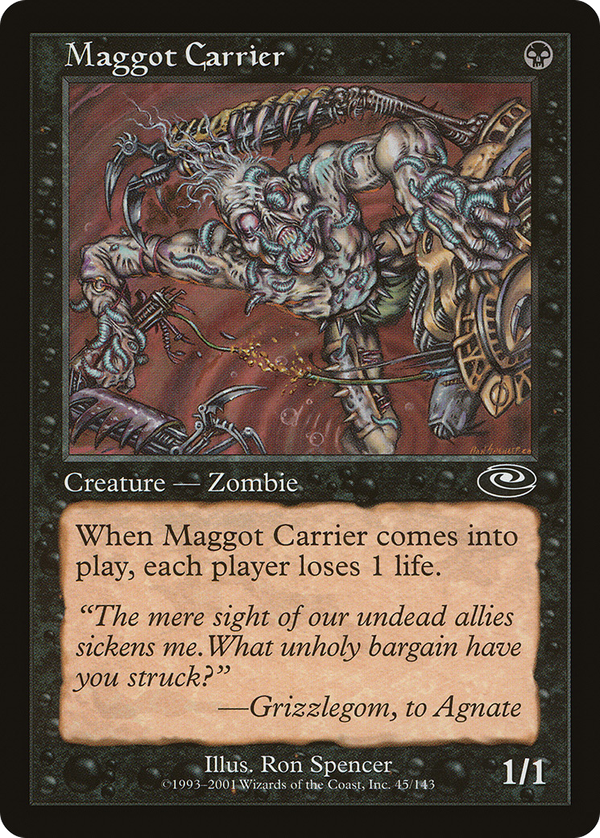
Maggot Carrier

Symmetrical life loss bolted onto a body so small the body is almost an afterthought: the relevant text is the trigger, and the relevant question is how to make a symmetric effect pay you more than it costs. As written, the entry charges both players a life, including you, so a single cast nets nothing useful: a wash that nudges everyone one closer to zero. The point has always been to break the symmetry by triggering it more than once. Flicker and reanimation engines turn one entry into many, and any shell that wants to lose life for value (sacrifice loops, life-as-resource decks) treats the self-cost as upside rather than tax. The cleaner exploit is recursion: a creature cheap enough to return repeatedly converts a one-time entry into a repeatable life-payment, and the 1/1 frame keeps each buyback trivial. That is the design tension at the center of it. A life-loss effect stapled to a creature is fundamentally more abusable than the same effect on a sorcery, because creatures get blinked, sacrificed, and reanimated in ways instants never are, and the question early designers had to answer was how much life a one-mana creature is allowed to drain off repeated entries before the loop becomes oppressive. Here the answer is one, symmetric: conservative enough to be safe, generous enough to matter once the count climbs. The body exists to make the trigger legal; the trigger exists to be triggered again.