Lutri, Pauper Otter


Its ancestor got banned before it could do anything. The original Lutri, the Spellchaser was struck from Commander early because its companion condition, a singleton deck, is already the format's default: attaching a free extra card to a ninety-nine-card deck cost nothing, and a companion that costs nothing to include is just a hundredth card everyone plays. This otter attacks the same problem from the opposite direction. Rather than a restriction that is trivial in the format it targets, its companion clause forbids any starting deck card bearing a silver, gold, orange, or purple expansion symbol: the rarity markers for uncommons, rares, mythics, and specialty cards. Only one corner of the game satisfies that by definition, since a deck of nothing but commons is the entry requirement itself, and no other format can meet it without cutting its own deck to ribbons. The two Lutris are a companion condition inverted: the first was free everywhere it mattered and therefore broken; this one is free for exactly one audience and prohibitive for the rest. Where the Spellchaser copied instants and sorceries, this one refills the grip on arrival: discard your hand, then draw three cards, a scaled-down Wheel of Fortune stapled to a 3/4 body that resets an emptied hand after an aggressive opening. From the "Pauper" in the name to the expansion-symbol clause, every part is tuned so one slice of the game runs it and everyone else stays locked out.
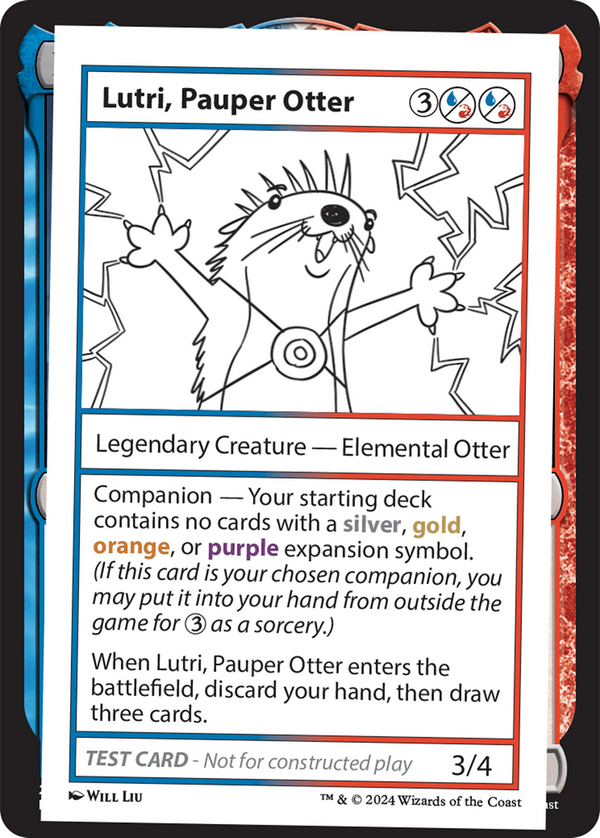
Rules text
as a sorcery.)
When Lutri, Pauper Otter enters the battlefield, discard your hand, then draw three cards.