Lurking Informant


Strip away the surgical milling angle and what remains is an information engine wearing a mill ability's clothing. Each activation looks at the top card of a target player's library before you decide whether to bin it, which means even when you decline, you have learned exactly what your opponent draws next. That "look, then choose" structure is the genuine design work: it turns a blunt deck-thinning tool into a repeatable scouting report that also happens to deny a known threat off the top. The cost keeps it honest. Two mana and a tap per activation means this never empties a library, only nudges it one card at a time, on a fragile 1/2 body that has to survive many turns to earn its keep. The hybrid casting cost was the forward-looking part, an early experiment in letting one card be paid for with either of two colors of mana, and it lets this slot into a blue control shell or a black graveyard-value shell with equal ease. That second mode is where the design gets quietest and most useful: feeding your own yard one selected card at a time, choosing the piece you want in the graveyard rather than the random one on top. It reads as a control-deck grinder from an era still learning how to price recursive card selection, where the slowness was never a flaw but the entire premise.
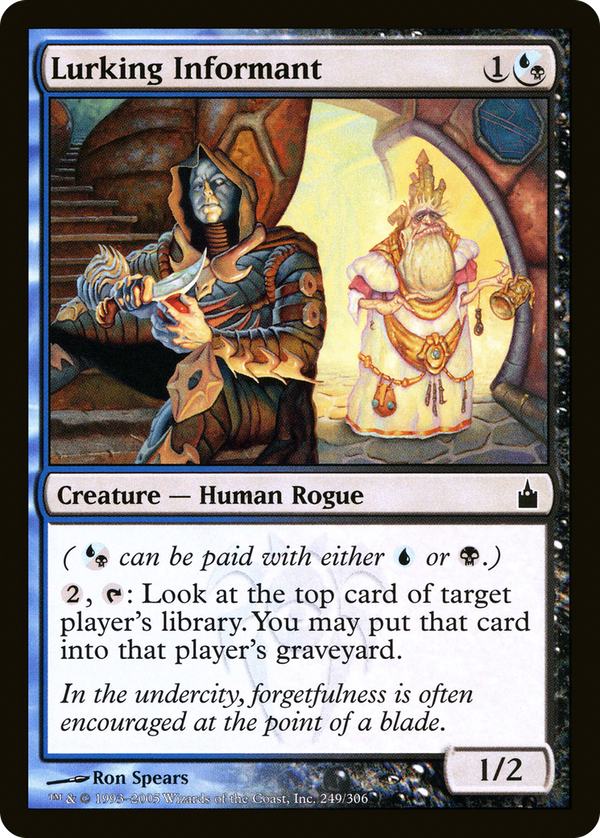
Rules text
can be paid with either  or
or  .)
.)
 ,
,  : Look at the top card of target player's library. You may put that card into that player's graveyard.