Lunar Hatchling



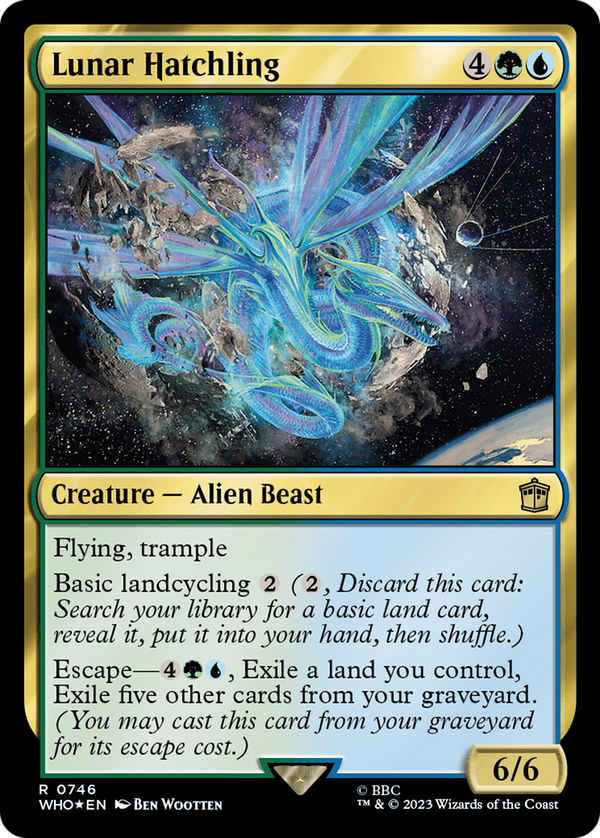
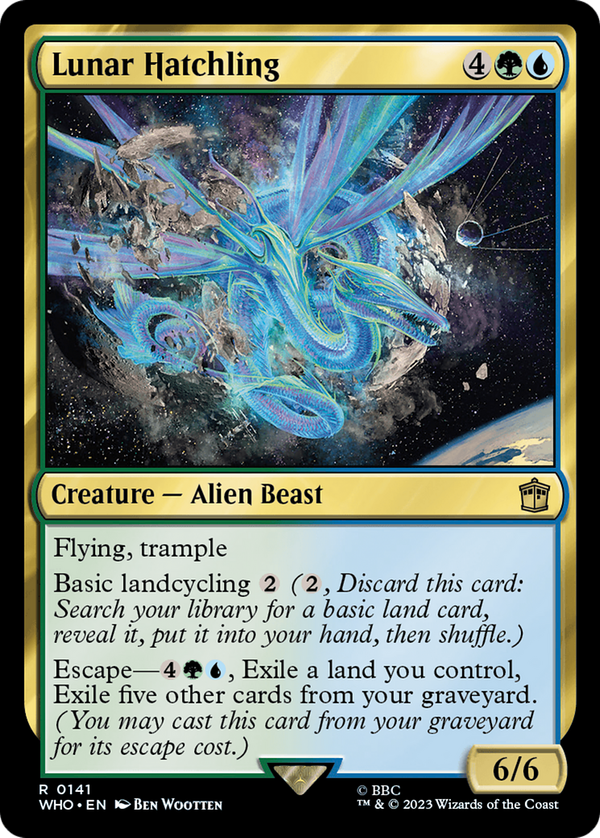
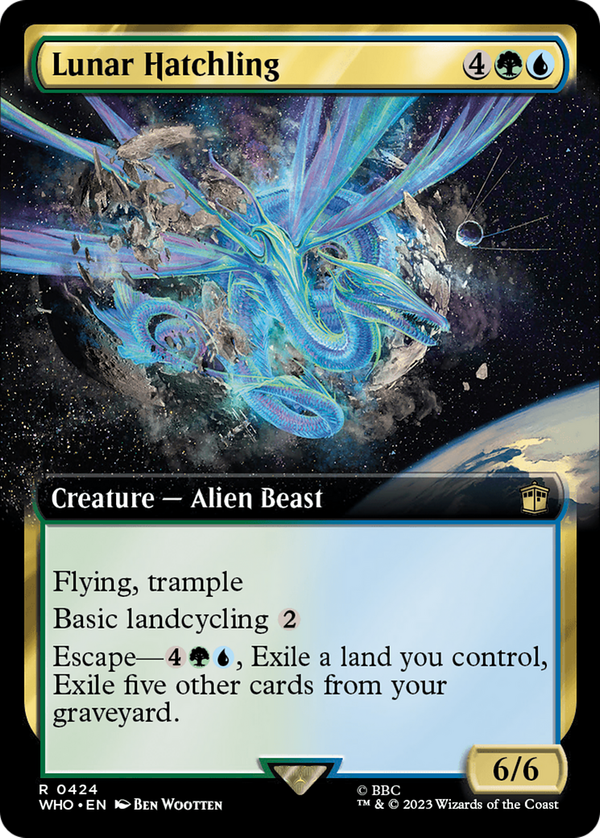
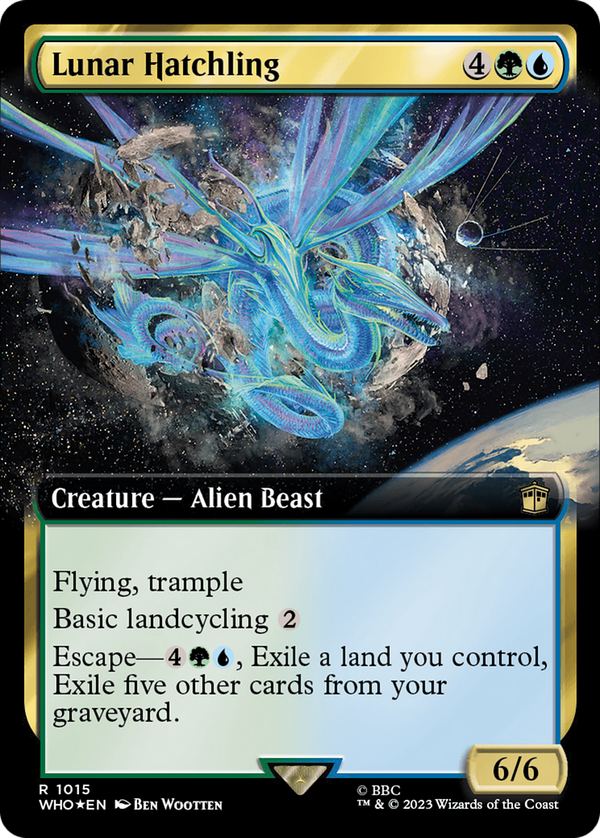
The design problem with a six-mana 6/6 flier is that it does nothing when you draw it too early and even less when you draw it too late. Simic's answer here is to stuff the card with escape hatches: every mode it prints exists so the card is never a dead draw at any point in a game. Early, it is a land: basic landcycling turns the beast into fixing when you are stuck on colors. Late, it is a threat that refuses to stay dead, casting itself from the graveyard by exiling a land you control plus five other cards. That escape cost is the balancing act: the land-exile costs you a permanent every time you recur it, and the five-card graveyard tax means you cannot loop it casually, so each return is a real resource decision rather than a free second cast. What ties the two ends together is the discard clause. The cards you fill the yard with in the early turns become the fuel that pays for the escape later. The 6/6 flying, trample body was never the point; it is the payoff that both halves of the card are building toward. This is graveyard-value design pointed at a color pair that historically leans on card advantage rather than recursion, and the whole thing is engineered so the same piece of cardboard serves as a land, a discard outlet's target, and a closer depending on when it shows up.
Rules text
 (, Discard this card: Search your library for a basic land card, reveal it, put it into your hand, then shuffle.)
Escape—, Exile a land you control, Exile five other cards from your graveyard. (You may cast this card from your graveyard for its escape cost.)
(, Discard this card: Search your library for a basic land card, reveal it, put it into your hand, then shuffle.)
Escape—, Exile a land you control, Exile five other cards from your graveyard. (You may cast this card from your graveyard for its escape cost.)