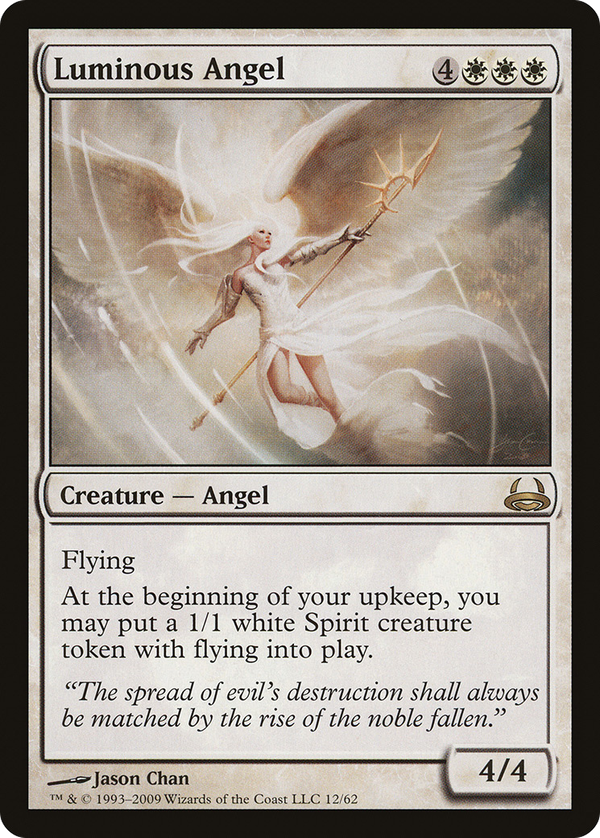
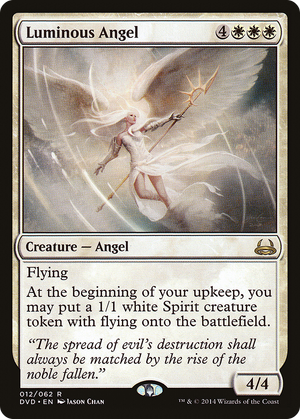
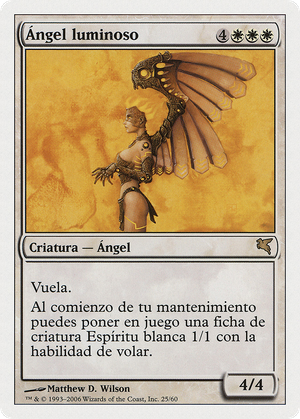
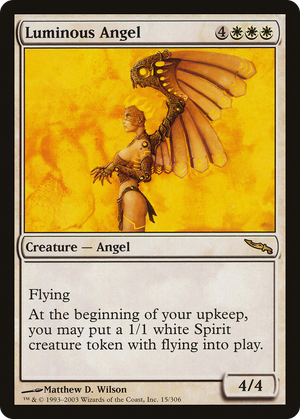
Luminous Angel


Triple-white in the casting cost is the first thing that dates this Angel: it belongs to an era when Wizards still gauged a creature's ceiling partly by how punishing its color requirements were, and a demand was a real cost in a multicolor-friendly artifact set. What that commitment buys is a slow engine rather than an immediate swing. The token clause fires on upkeep, not on entry, so the first Spirit only arrives the turn after you cast, and the army builds one flier per turn from there. That tempo profile is the whole tension: a seven-mana 4/4 flier is unremarkable on rate, but every turn it survives widens the gap, turning a single threat into an aerial swarm that any sweeper has to catch before it snowballs. The liability is structural. Because the payoff is deferred, cheap removal answers it for a fraction of the investment before a single Spirit ever appears, so it has to dodge interaction across several turns just to break even. It reads as a finisher for a deck that already controls the board and wants a clock that rebuilds itself. The design idea (a flier that manufactures more fliers on a clock) is one Wizards has returned to repeatedly with cheaper, faster bodies; this is the lumbering early draft of that template.