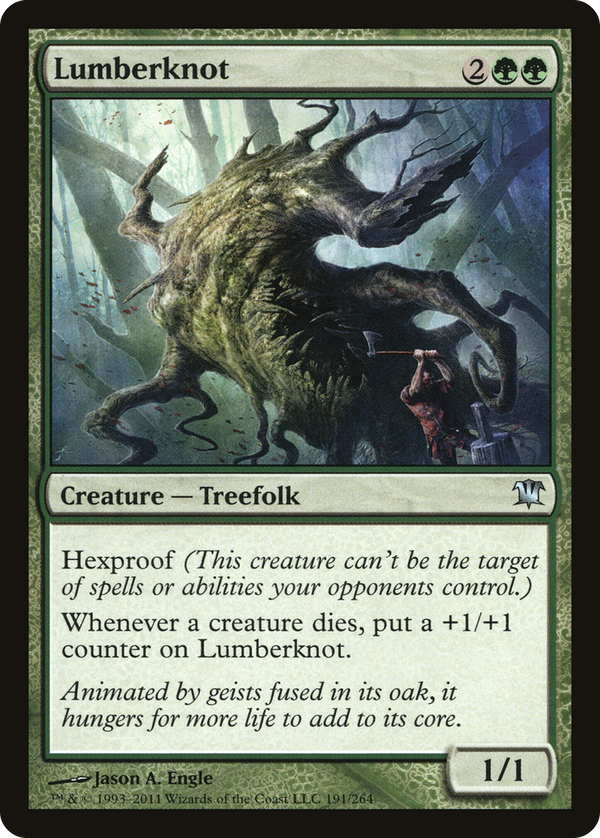
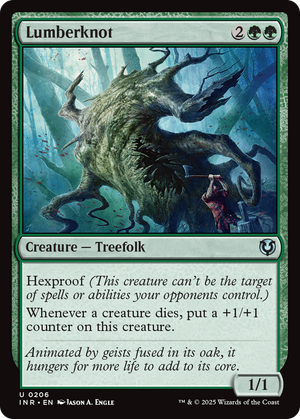
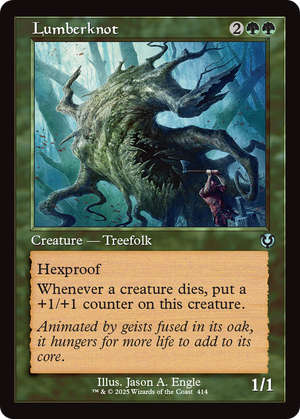
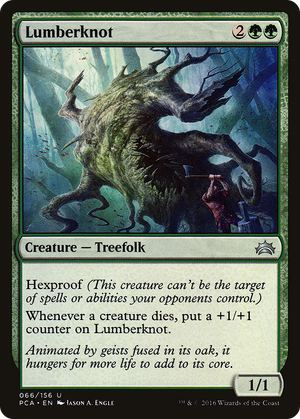
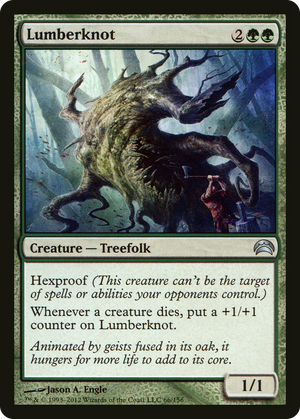
Lumberknot


The hexproof is what makes the death-trigger payoff coherent. A creature that grows on every death (yours, your opponents', incidental tokens, every chump block and combat trade) is only a threat if it survives long enough to cash in those counters, and growth-on-counters bodies are exactly the kind of thing aggressive decks aim removal at before they snowball. Stapling hexproof to the engine closes the obvious answer: opponents cannot spot-remove the accumulator, so the question becomes whether they can race it, block past it, or wrath the board out from under it before the counters pile up. That last out is the real constraint, because nothing here protects the base 1/1 from a sweeper that hits everything: a board wipe early enough kills it alongside the creatures that would have fed it, and it only outlives a damage-based sweep once it has already grown large. The deeper tension is that the trigger does not care who controls the dying creature, so it tends to sit and fatten during the grindy, attrition-heavy game it is least equipped to end, since the body starts small with no evasion. An untargetable counter that cannot convert its own size into pressure is the whole design: it wants a stalled, chip-heavy board where creatures trade constantly, and it wants you to supply the reach, trample, or sacrifice loop it lacks. It is a treefolk built to outlast, not to close.