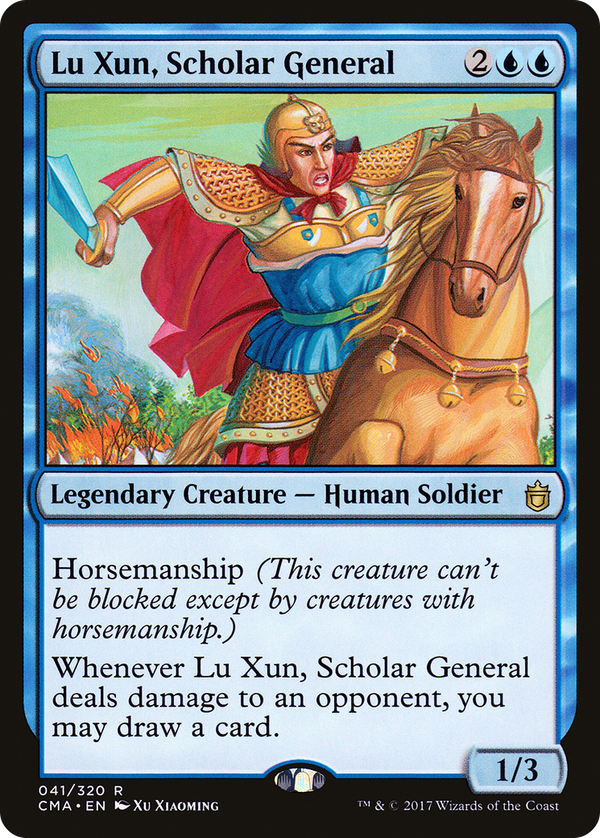
Lu Xun, Scholar General


One point of combat damage a turn is not a clock; it is a delivery system. The 1/3 body will never race anyone, and it was never built to. What matters is that the point lands almost every time: horsemanship restricts blocking to creatures that also have horsemanship, and that pool has always been vanishingly small, a self-contained evasion keyword that answered to fewer blockers than fear ever did. So the attack step stops being about damage and becomes a card-draw trigger. Every connection offers a draw, optional, without committing more resources or telegraphing anything, which turns a lone unblockable pinger into a repeatable cantrip that keeps the hand full while the rest of the deck does the work. That is the design logic behind the low power: a bigger body would tempt you to build it as a threat, and it is not a threat, it is an engine. It sits in a quiet lineage of small evasive blue creatures whose evasion exists to guarantee the second ability resolves, not to end games. The tension the card lives inside is that its own damage output is trivial, so it rewards a deck that reads the combat step as "did I draw a card?" rather than "how close is the opponent to dead?" The unblockability is not the payoff; it is the guarantee that the payoff triggers.