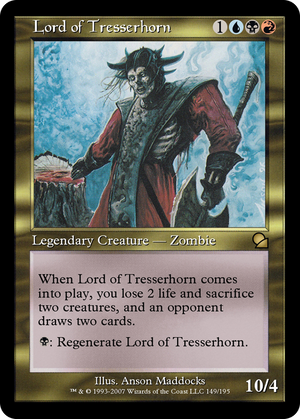
Lord of Tresserhorn




A 10/4 for four mana that bills you three ways at once: two life, two creatures, and two cards handed to an opponent, all stapled to a single enters-the-battlefield trigger. This is the costed-drawback design philosophy of mid-90s Magic taken to its logical extreme, the same school of thought that produced Juzam Djinn and later Phyrexian Negator, where raw stats came chained to invoices that came due fast. The tension is that the body is genuinely enormous for the era and the cost, but everything around it is engineered to make you earn the swing. Crucially, the drawbacks are not casting costs; they live on a triggered ability that goes on the stack when the Lord enters, which means an opponent can respond to it (a removal spell in reply leaves you having sacrificed two creatures and gifted two cards for a body that never connects). The regeneration clause is the one piece of the design pointing toward salvage: a 10/4 dies to almost anything, so the black activation keeps the payoff on the table after you have already paid. The trigger is non-optional and front-loaded, so the card wants a build where the sacrificed creatures are not really lost (tokens, recursion, death triggers) and the gifted cards never get spent (because the game ends first). That synthesis is the whole puzzle: an attacker only as good as the engine you bolt it onto.
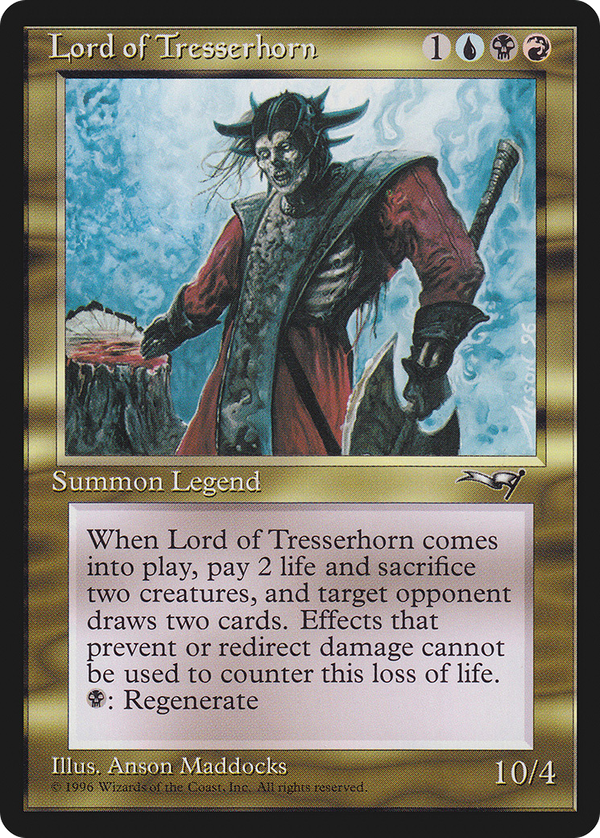
Rules text
: Regenerate Lord of Tresserhorn.