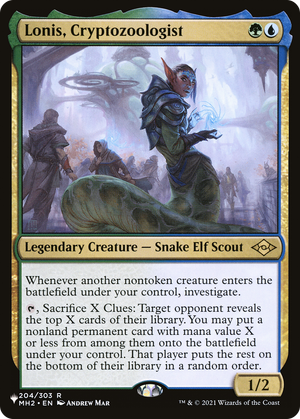
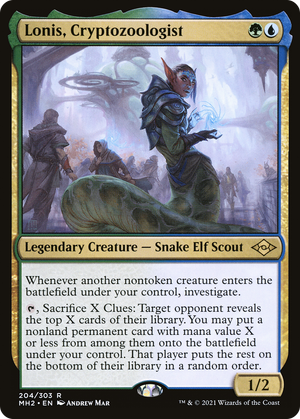
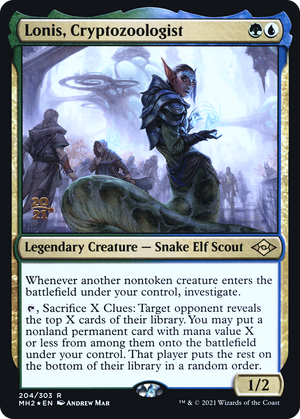
Lonis, Cryptozoologist


Most Clue engines are honest value machines: crack a token, draw a card, move on. This one bends that currency toward larceny. Every other nontoken creature that joins the board leaves behind evidence, and a Simic body this cheap has no trouble sitting back while the creatures accumulate. The payoff ability converts that hoard into a scaling steal: the number of Clues you sacrifice sets both how deep you dig into an opponent's library and how expensive a permanent you can lift from it. Feed it one and you might snag a mana dork; hoard five and you are reaching for their bomb. The interesting friction is that these are the same tokens: every Clue you sacrifice for cards is a Clue you did not spend on theft, so each turn the deck weighs a grindy card-advantage plan against a heist. Investigation itself never runs dry (it triggers on another nontoken creature you control entering, whether or not this creature is tapped, so activating the theft costs nothing on the accumulation side); the Clues, and which job you assign them, are the only scarce thing. A board that can flood creatures faster than it burns through its own Clue supply gets to do both. That repeated fork, drawing your own cards or taking someone else's, is what the design keeps asking you to answer.
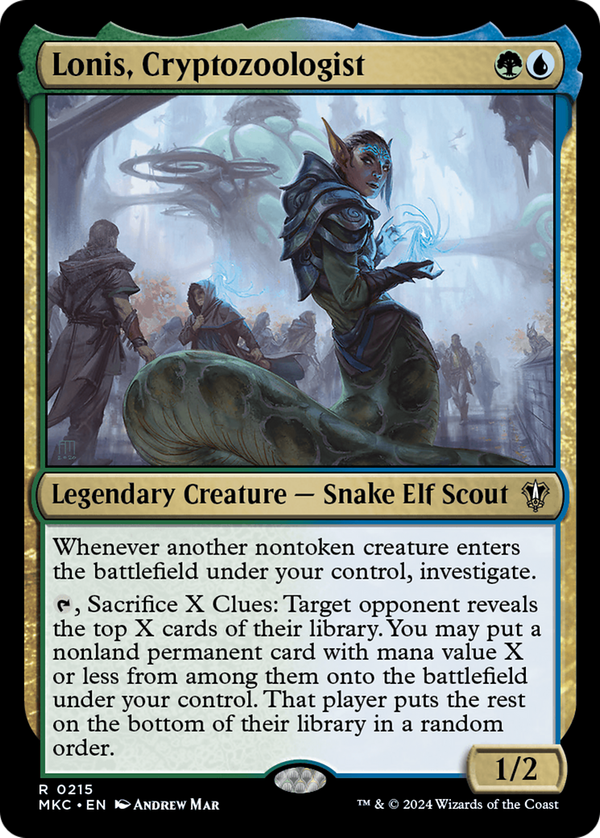
Rules text
 , Sacrifice X Clues: Target opponent reveals the top X cards of their library. You may put a nonland permanent card with mana value X or less from among them onto the battlefield under your control. That player puts the rest on the bottom of their library in a random order.