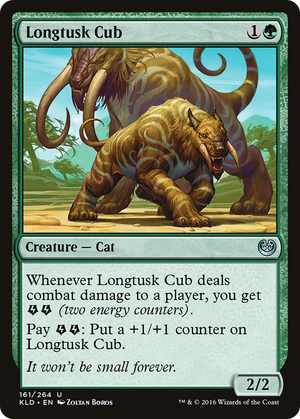
Longtusk Cub


The whole engine runs on a single conditional: the Cat has to land combat damage on a player. The mechanic was built to be slow-accruing, a resource you bank across turns and spend in bursts, but this two-drop collapses that loop into a tight feedback cycle. Each hit that connects generates exactly the two energy a single +1/+1 counter costs, so the body pays its own growth: a bigger Cat gets through more reliably or trades up in combat, which funds the next counter, and so on. The growth is permanent (the counters stay long after the energy is spent), which distinguishes it from a pump spell or a temporary firebreathing effect: it ratchets up and never resets. What holds the engine in check is that it never primes itself against a wall. It has to deal its damage to a face, so a defender or chump blocker stalls the whole thing until the lane clears or the Cat gains a way through: trample turns a blocked attack into partial damage that still triggers, evasion grants sidestep the block entirely, and removal simply opens the red zone. That dependency on connecting is the cost of the rate, and it points the card toward shells built to force damage through. It also reads as a deliberate stress-test of the mechanic, an early demonstration that energy could anchor an aggressive curve rather than just feed slow value engines, by tying generation and expenditure to the same creature in the same combat step.
Rules text
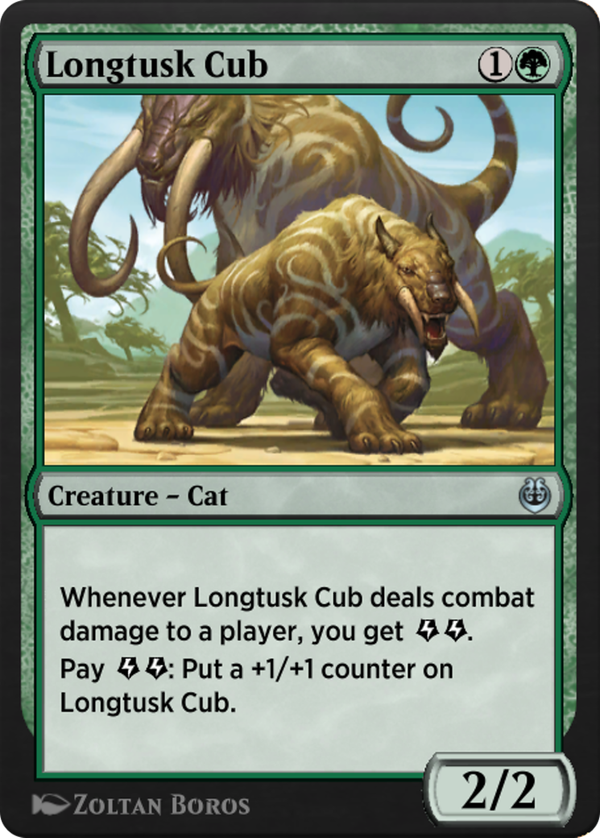
 (two energy counters).
Pay : Put a +1/+1 counter on this creature.
(two energy counters).
Pay : Put a +1/+1 counter on this creature.