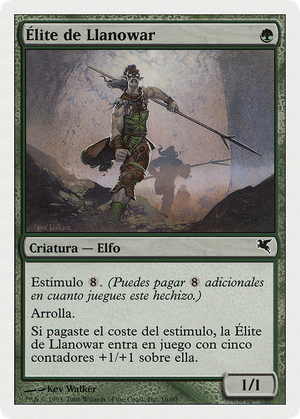
Llanowar Elite

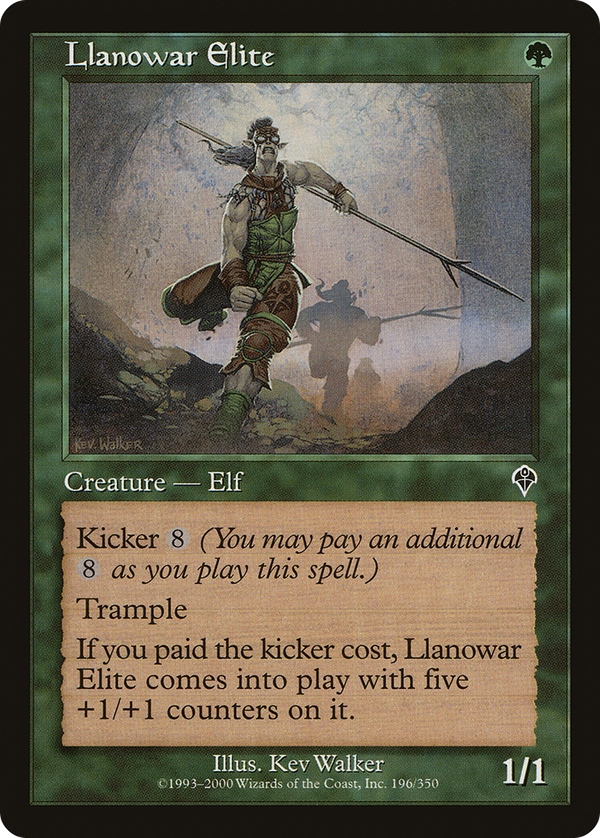
One green buys a 1/1 trampler whose entire purpose, in that mode, is to fill out an aggressive opening and chip in a point of damage. Feed the optional eight, and the cost balloons to nine mana for an elf that shows up wearing five +1/+1 counters: a 6/6 that wants to crash through whatever the late game has parked in front of it. The eight-mana gulf between those two settings is the whole design. There is no middle gear, no partial payment, just a one-drop that doubles as a finisher. Trample is the connective tissue that makes both halves coherent, since a 1/1 still wants to slip past early defenders and a 6/6 still wants to push damage through chump blockers. The optional-cost mechanic of this era usually worked as a late-game release valve, a way to keep a cheap card relevant when you drew it flooded out, but this one runs the math to its breaking point: a single slot scaled across nearly the entire curve by one yes-or-no payment. What keeps it a museum piece is that almost no deck wants both jobs from the same card. The aggressive shells that play one-drops rarely float nine mana, and the decks that comfortably reach nine have heavier threats to spend it on. It endures as a clean demonstration of how far a kicked creature can be stretched, the front and back of a deck folded into one elf.
Rules text
 (You may pay an additional as you cast this spell.)
Trample
If this creature was kicked, it enters with five +1/+1 counters on it.
(You may pay an additional as you cast this spell.)
Trample
If this creature was kicked, it enters with five +1/+1 counters on it.